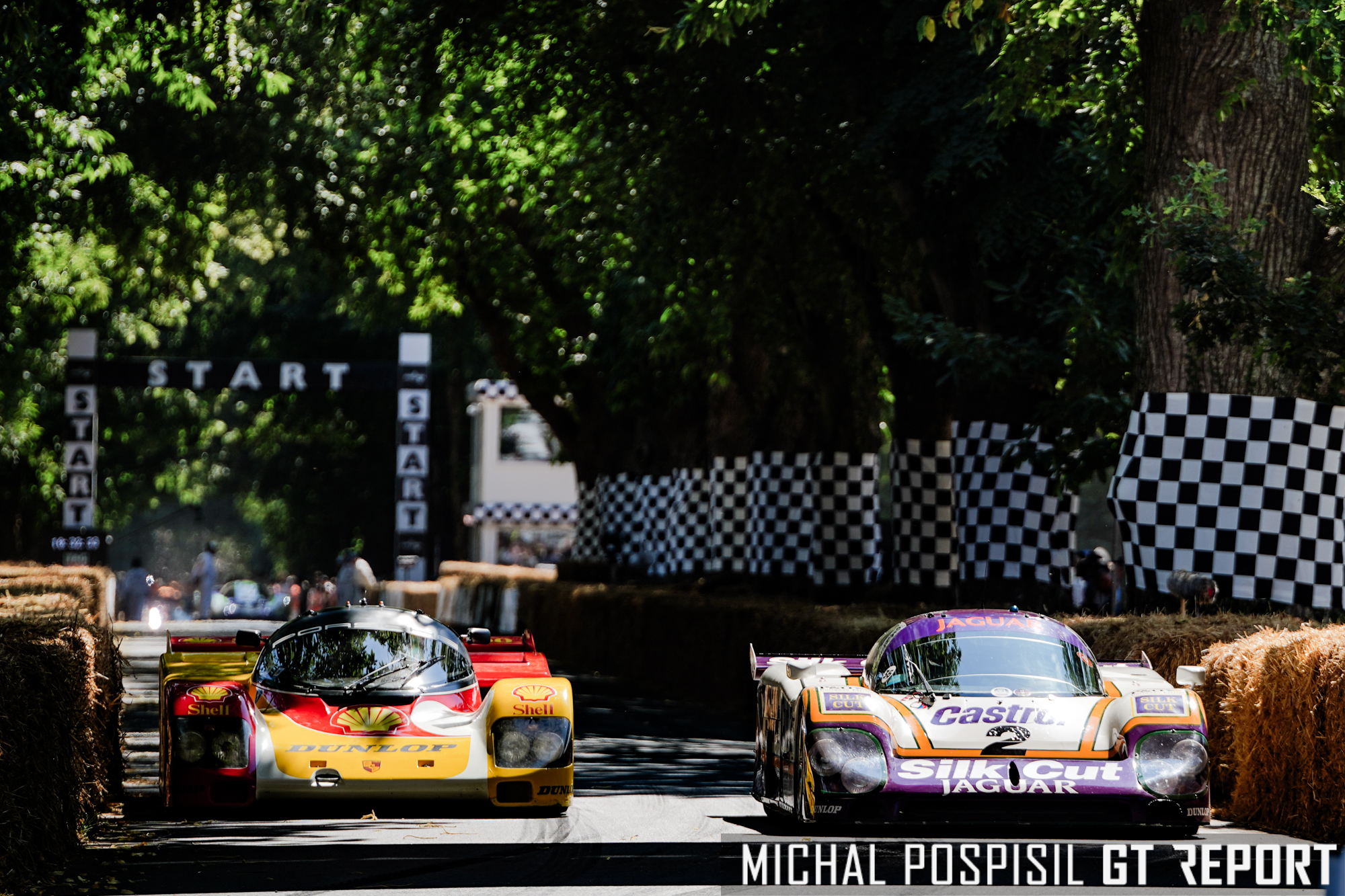
The Jaguar XJR-9 LM – an “unlucky” car no one wanted to drive – became one of Le Mans’ greatest legends in 1988, ending Porsche’s seven-year reign in a race that came down to a failing gearbox, a determined Jan Lammers and thousands of ecstatic British fans. At Goodwood 2026, the iconic Silk Cut Jaguar reunited with its old Porsche rival – and with the people who helped make its story unforgettable.
Some racing cars become famous because they are beautiful. Others become famous because they are fast. And then there are the cars whose legend comes from something far more powerful: the story of what they survived.
The 1988 Jaguar XJR-9 LM is one of those cars.
Its purple-and-white Silk Cut livery, enormous rear wing and thunderous V12 have made it one of the most recognisable sports prototypes ever built. Beneath the glamour, though, lies a story of pressure, rivalry, mechanical failure and sheer determination.
At the 2026 Goodwood Festival of Speed, the XJR-9 LM was reunited with another survivor from that extraordinary era – the Porsche 962 that had been its principal adversary at Le Mans. Goodwood’s theme, ‘The Rivals – Epic Racing Duels’, could hardly have been more appropriate, bringing the 1988 Jaguar and Porsche together again almost four decades after they had fought for victory on the world’s most famous endurance-racing circuit. This time, instead of fighting for the chequered flag, they shared the spotlight.
For Jaguar, the significance of that 1988 victory went far beyond a trophy. GT REPORT was lucky enough to put a few questions to the Managing Director of Jaguar Daimler Heritage Trust, Matthew Davis, about this iconic car and its famous win at Le Mans. As Davis explains, Jaguar’s reputation was hanging by a thread that year – and, as it turned out, so was the car itself.

Jaguar XJR-9 LM passing by the Goodwood House
When Jaguar Came Back for Le Mans
Jaguar’s return to top-level endurance racing was not an overnight success. Group 44 had brought the marque back to Le Mans in the mid-1980s before Tom Walkinshaw Racing took over the factory programme and, together with designer Tony Southgate, developed the XJR-6 for the 1986 World Sports-Prototype Championship. The XJR-8 followed in 1987 and, although Jaguar was becoming increasingly competitive, Le Mans continued to escape them.
Then came the XJR-9. The car was the next evolution of TWR’s hugely successful Jaguar prototype programme, keeping the fundamental architecture and naturally aspirated V12 concept while developing the aerodynamics and endurance characteristics needed to survive the world’s toughest sports-car race. The result was an extraordinary machine: a seven-litre V12 Group C prototype producing roughly 750bhp at Le Mans, wrapped in one of the most famous liveries in motorsport.
But 1988 was different. Winning Le Mans was no longer just a sporting ambition for Jaguar; it had become a commercial necessity. Matthew Davis explains that the company’s wider situation had begun to change: the American success that had underpinned Jaguar’s motorsport programme was no longer enough, and chairman John Egan knew the company needed something enormous. Le Mans was the opportunity to deliver it.
“It was really important for Jaguar to win the Le Mans 24 Hours in 1988. All the kinds of economic benefits that had helped them succeed in America were starting to fall away. And John Egan knew they had to sell a lot of cars.”
“The well-known phrase “Win on Sunday, sell on Monday” couldn’t have been more fitting for the British manufacturer. The pressure was enormous. They had to win Le Mans and sell cars with essentially the same engine. So basically, it was very close to that plan being a failure if Jaguar didn’t win that race. This really helped Jaguar at that time when they really needed things to work.”
Even with success in America and in the World Sports-Prototype Championship, Jaguar still needed to prove its mettle in the toughest race in the world. Davis puts it plainly: the company’s reputation was hanging by a thread.

Jaguar XJR-9 LM and its iconic Silk Cut livery at the Festival of Speed 2026
The XJR-9: Purple, White and Absolutely Furious
There was nothing subtle about the way the XJR-9 looked. Long, low and brutally purposeful, it carried Jaguar’s legendary V12 behind the driver and wore the Silk Cut colours that became inseparable from the company’s endurance-racing identity.
The engine had a direct connection with Jaguar’s earlier racing success, evolving from the V12 used in the TWR XJS that had conquered the 1986 European Touring Car Championship. Matthew Davis remembers the significance of that link. His father owned a Daimler Double Six, a V12 saloon from the same era.
“I remember him standing in the pub and telling people, ‘Oh well, it’s got the same engine as the Le Mans car.’”
That was exactly what made Jaguar’s racing programme so powerful: the technology on the circuit could be tied to something sitting in a customer’s driveway. It sold more than a racing dream; it sold the idea that Jaguar’s road cars carried some of the same DNA.
Jaguar Had Earned Its Shot
By 1988, Jaguar was no longer an outsider. Its World Sports-Prototype Championship campaign showed that the XJR-9 could beat the best in the world: the Silk Cut squad won six of the championship’s 11 rounds, and Martin Brundle took the drivers’ title. Le Mans was the obvious big prize still missing.
One enormous obstacle stood in the way: Porsche. The German manufacturer had won Le Mans seven times in a row from 1981 to 1987, dominating the era with the 956 and 962. In qualifying for the 1988 race, Porsche showed exactly why it remained the benchmark. Hans-Joachim Stuck put the factory Porsche 962C #17 on pole with a 3m15.640sec, and Porsche locked out the first three places on the grid.
Jaguar had come to challenge the king, and it would have to do it over 24 hours.

Managing director of Jaguar Heritage Trust Matthew Davis on the right with the lead technician and David Brabham
The Car That Wasn’t Supposed to Be Lucky
There is another remarkable twist to the story: the winning chassis was not the one anybody regarded as lucky. Davis explains that chassis 488 had a reputation long before Le Mans.
“Actually, the car was a really unlucky car. Before it went to Le Mans, it had never finished a race. So the guys who drove it at Le Mans weren’t too keen on having chassis 488, seeing as it was an unlucky car.”
And yet this was the car that survived, completed 394 laps and beat Porsche.
Le Mans 1988: Porsche Had Pole, Jaguar Had the Pace
The race started at 3 o’clock on 11 June 1988, and the balance of power shifted almost at once. The Porsche 962s had been spectacular in qualifying, their turbocharged engines delivering enormous performance, but the Jaguar was quicker away from the line and had moved ahead of them by the second lap.
The battle quickly became one of the great Jaguar-versus-Porsche confrontations. Three factory Porsches took turns at the front, but the #2 Jaguar XJR-9 LM of Jan Lammers, Johnny Dumfries and Andy Wallace remained the constant threat.
Davis has plenty to say about that driver line-up.
“Jan Lammers was a fantastic guy to have leading this car. And Andy Wallace was very new to this type of racing at that time. Johnny Dumfries was also relatively new to this spec of car. So they really brought a lot of new knowledge and wisdom to this car. What they noticed when they had set the car up, it was 15mm too low at the back. At speed, that lifted the car up. It was not the correct setting. But Jan noticed that on the Mulsanne straight, he got a higher top speed than anyone else. It was a bit trickier through the S’s. But he said to the other boys, ‘Look, let’s leave it where it is.’
“They all thought it was worth running. And as a function of that, the car ran a bit cooler, it had a better top speed. And I think that’s what helped preserve the gearbox and gave it that ultimate engine speed.”
There were setbacks on both sides. Klaus Ludwig in the leading Porsche #17 missed his pit signal while battling the Jaguar and nearly ran out of fuel, losing precious time as he crawled back towards the pits. The #18 Porsche of Bob Wollek, Sarel van der Merwe and Vern Schuppan then led for around six hours before an engine failure ended its challenge, and the Andrettis’ Porsche also ran into problems. The race was becoming a war of attrition, and through all of it the #2 Jaguar simply kept going.

Jaguar XJR-9 LM at the Festival of Speed
24 Hours, Five Jaguars and One Relentless Porsche
Jaguar had entered five XJR-9 LMs, but only the #2 would complete the full distance without a major failure. The #22 finished fourth and the #21 came home 16th, while the #1 of Martin Brundle and John Nielsen retired with a head-gasket problem and the #3 of John Watson, Henri Pescarolo and Raul Boesel also fell out.
Porsche #17 refused to disappear, with Derek Bell, Hans-Joachim Stuck and Klaus Ludwig keeping the pressure on. The margin between the leading contenders was often tiny. Porsche had the outright qualifying performance; Jaguar had consistency, and perhaps a little more luck.
The Night the Jaguar Refused to Die
There were moments when the #2 Jaguar seemed almost indestructible, and others when its survival looked far less certain. At around 6:30 in the morning, Jan Lammers hit a bird and forced a windscreen replacement. Later, changing weather complicated an already difficult race, rain making the circuit slippery and forcing teams to rethink their tyre choices.
Porsche kept attacking and Jaguar kept answering as the race edged towards its final hours. Then came the moment that would define the whole race: the winning Jaguar’s gearbox began to fail. The “unlucky” chassis 488 was on the brink of failing to finish a race yet again, and this time it was the iconic Le Mans, with the whole world watching and Jaguar needing the win to secure its future.
Fourth Gear to the Finish
With the race approaching its conclusion, Lammers could feel that something was seriously wrong with the gearbox. The solution was brutally simple, and Davis recalls just how close the car came to failure.
“In the last section of the race, just before the last fuelling pit stop, Jan Lammers noticed that the gearbox was on its way to failing. Because car #1 had a gearbox failure earlier in the race, other drivers had explained to him what had happened and how they felt it going, so he knew what to look out for. So when he felt the problem coming, he put it in 4th gear and just kept it there. And managed to just nurse the car home.
“When they went in for a fuel stop, and it was very busy in the pits at that time, because everyone knew it was the last push. So the guys managed to refuel it, lanced over the car, and managed to just partly push it out in 4th gear, without the Porsches noticing.
“The Porsches were trying to hunt it down, but they didn’t realise what the potential disaster was,” Davis added.
The TWR team knew the situation was desperate, and Tom Walkinshaw ordered the other surviving Jaguars to shadow the #2 car. From the outside, three Jaguars closing up to cross the line together looked like a carefully choreographed celebration. In reality, it was a desperate move to protect the leading car, which was being hunted down by the #17 Porsche.
“Everybody thought he was trying to get that 1-2-3 picture. He just said to them, ‘If it fails, push the number 2 car over, and get it over the finish line.’”
Davis sums it up: “So that’s how close it was.”
By that point the winning car was barely being raced at all; it was being nursed home. The drama even left a physical souvenir behind.
“After the race, the chief engineer Eddie Hinckley kept a piece of the broken shaft from the gearbox as a paperweight,” said Davis with a smile.
To the thousands watching from the grandstands, Jaguar was about to complete one of the greatest victories in its history. Inside the TWR garage, they knew the car was held together by almost nothing.

Gear stick inside the cockpit of the XJR-9 LM
A Sea of Jaguar Flags
The official result shows the #2 Jaguar completing 394 laps, covering 5,332.79km at an average of 221.665km/h, with Porsche #17 finishing second, 2 minutes and 36 seconds behind. The figures alone can’t capture what happened at the end.
As the final lap approached, thousands of ecstatic British fans began flooding onto the circuit. The atmosphere had become uncontrollable, the start/finish area overwhelmed as spectators surged towards the Jaguars, surrounding the cars and filling the track. The situation got so out of hand that, after the three Jaguars had crossed the line, marshals had to divert the rest of the field into the pit lane to complete the race there.
The fans had waited 31 years for this – Jaguar had last won Le Mans in 1957 – and now, after Porsche’s seven consecutive victories, a British manufacturer was about to take the crown back.
Jan Lammers would later recall the huge British presence on the pit straight, with Jaguar flags everywhere, describing the battle with Porsche as one fought “tooth and nail.”
Among those fans was Steven Jones. When GT REPORT went to see the car in the paddock on Sunday, a small group of enthusiasts was closely admiring it, and two of them were wearing Jaguar Silk Cut merchandise.
“I bought this T-shirt my son is wearing today at Le Mans back in 1988,” said one of the fans with a hint of nostalgia in his voice.
Steven Jones and his friends had travelled to Le Mans through the late 1980s, following Jaguar during its return to the sport. For him, the trips were about more than motor racing.
“I went to Le Mans from 1986 through to 1990 and I followed Jaguar as a younger man and it was just a boy’s week away. It was always such good fun for the whole 24 hours. The years that Jaguar won, they always meant more to me.”
And the 1988 victory?
“I was totally elated when it won. You can never pick a winner. You can always hope for a winner, but it’s such a hard race. It made the trip for me and my mates so special. It was just great.”
The memory never faded. One can only imagine the thrill in the air as the German giant was finally beaten by the British Jaguar on French soil.
“Back in that era, it was just Porsche, Mercedes and Jaguar. So we were there as all Englishmen gunning for them,” Jones added.
Decades on, standing beside the same car at Goodwood, Jones could barely believe it.
“It’s always been in my heart; this has always been my favourite racing car. I love the livery, I like the shape. I have admiration for the designers and the workmanship and the technology. It’s just an icon for me. So to see it today at Goodwood, it’s just a dream. It’s just so fabulous that the cars are still kept in running order.”
For fans like Steven Jones, the XJR-9 created unforgettable memories and still holds a special place in their hearts today.

XJR-9 LM fan club. Steven Jones on the right
More Than a Racing Car
The XJR-9 is not simply preserved behind glass. The Heritage Trust sees its job as keeping these cars connected with people, and Matthew Davis puts it simply.
“Jaguar gifted this car to us, Jaguar Daimler Heritage Trust. So it’s our job to take this car out to every event we can, and put it in front of the people. I have to say, when you walk through a crowd with this car, people love this car. It means a lot to people. It’s such a unique car. Just the shape of it. Even the livery is beautiful.
“Actually, on our first day of the Festival of Speed on Thursday, we met the person who was head of the Gallagher Tobacco Company, branding the team. He was the guy that put all the sponsorship together. Physically, the design of it. And he came to see the car. It was really cool to meet them. That’s why we love these festivals.”
That is why the XJR-9 continues to run. We asked Davis whether he has driven the car himself.
“I have not, no. I have a full licence, so I could, but I don’t want to be that guy that sticks it in the wall,” Davis answers jokingly.
The Heritage Trust even prefers to have its own lead technician drive the car, as Matthew explains: “Our lead technician is the one who always drives it if we don’t have a famous driver. I would rather the guy who fixes it drive it than anybody else. He has the mechanical sympathy to understand what the car needs.”
It is a fitting philosophy for a machine that survived one of the most demanding races ever staged. For this outing at the Goodwood Festival of Speed, though, the Heritage Trust found a more than capable pair of safe hands: 2009 Le Mans 24 Hours winner and former Formula 1 driver David Brabham.
David Brabham: A Different Chapter of the Jaguar Story
David Brabham wasn’t among the drivers of the 1988-winning Jaguar, but his own career would become deeply tied to Jaguar and TWR. For him, the XJR-9’s victory came at a fascinating moment. In an exclusive interview for GT REPORT, Brabham looked back at the early stages of his career.
“The XJR-9 won Le Mans in 1988 and that was my first year in the UK, when I came over from Australia.”
As a young driver, he had watched the great sports prototypes from afar. Decades later, he would climb into one.
“I’ve always loved the Le Mans prototypes as a kid, watching those and obviously coming over to Europe at that time and seeing this car win that race and then be able to have the opportunity to drive it is pretty cool.”
Brabham would later race Jaguar’s XJR-14 in the 1991 World Sports-Prototype Championship and the Jaguar XJ220 in 1993 at Le Mans. The XJR-9, as a predecessor to those machines, represents a different chapter of his Jaguar story – but a deeply personal one. The similarities between the cars only make the experience more familiar.
“I have raced the XJR-12 and obviously they didn’t evolve massively other than the aerodynamics because the tub looks the same, the gearbox feels the same, the engine feels the same and all the switches all look very familiar to me.”
His verdict on climbing back into the cockpit: “It just feels like an old glove on the hand.”

David Brabham getting ready before driving the Jaguar XJR-9 LM at Goodwood
Trusting the XJR-9
For Brabham, much of the XJR-9’s magic is in how it drives.
“It’s so easy to drive, the drivability of the V12 engine is phenomenal.”
Rather than a machine that constantly threatens to bite, he describes one you can trust.
“I think whenever you get in a car, even just driving down to the start line, the way the car sits on the tyre you know whether or not that car is in the window or it’s not in the window. It’s really strange, even when you’re not going very fast, it’s just the way the aerodynamics work, it just feels right on the tyre and you just know it. When you start driving, the car just sits on the ground. You can trust it. You’re not fighting, it’s not dancing on top of it. It’s just well suited.”
That is part of why these cars stay special to the people who drive them. The numbers are impressive and the history is extraordinary, but a racing car ultimately has to talk to the person behind the wheel – and the XJR-9 still does.
Brabham’s own career would eventually take in victories at Le Mans, Daytona and Sebring, along with success for Jaguar, Bentley and Aston Martin. When he returned to the XJR-9 at Goodwood, the feeling was immediate.
“As soon as I sat in it, it was like, oh, I remember this, I feel at home.”
Then Brabham adds with a laugh: “It’s like going back and seeing an old girlfriend, you know what I mean? Straight away you just felt familiar. I like the look as well. It’s iconic.”
How did it feel to be involved in motorsport with a brand like Jaguar?
“I’ve been very fortunate to drive a Jaguar back in 1991 in the World Endurance Championship in the XJR-14 Silk Cut car. And then after that I raced at Daytona and Sebring and we won our class at Sebring. We finished second overall and I think we finished fourth at Sebring. When you drive for such an iconic brand as Jaguar, as a works driver, it’s a pretty good feeling.
“And then in 1993 I stood on the podium at Le Mans with the XJR-220 and it was actually the XJR-15 race at Monaco that got me into the Jaguar fold with TWR, with Tom Walkinshaw Racing.”
The XJR-15 competed in a single-make racing series, the Jaguar Intercontinental Challenge, which supported three Formula 1 races – Monaco, Silverstone and Spa – in 1991.
“So I’ve driven a few Jags and to have stood on the podium at Le Mans with Jaguar was pretty cool, as I did with Bentley and Aston Martin, so I have completed the British trio. It’s an honour to be able to drive for people like Jaguar and those guys. So it really brings back nice memories.”

Inside the cockpit of the Jaguar XJR-9 LM
The Rivalry Returns at Goodwood
In 1988, Jaguar and Porsche represented two very different approaches to the same obsession. Porsche had the experience, the turbocharged speed and seven consecutive Le Mans victories. Jaguar had the V12, the TWR operation, a growing confidence and an enormous weight of expectation on its shoulders.
At the 2026 Festival of Speed, those two worlds came together again. The Jaguar XJR-9 and Porsche 962 were both entered for the Mulsanne to Molecomb sports-car celebration, with five-time Le Mans winner Derek Bell driving the Porsche. With Goodwood’s theme built around rivalries coming back to life, it was impossible to watch the two cars run together and not think back to that extraordinary race.
This time there was no stopwatch pressure, no fuel calculation and no gearbox threatening to explode – just the sound of the mighty Jaguar V12, the Porsche flat-six and two legendary silhouettes sharing the same stretch of tarmac once again.

Le Mans 1988 rivals Jaguar XJR-9 LM and Porsche 962 going up the hill at Goodwood Festival of Speed 2026
Still Roaring
There are plenty of ways to describe the 1988 Jaguar XJR-9 LM: a seven-litre V12 Group C prototype, the sixth Le Mans-winning Jaguar design, a product of Tom Walkinshaw Racing and the machine that beat Porsche after seven consecutive victories. All of them are correct, yet none of them quite explains why the car still feels so special. For that, you have to look at the people.
Eddie Hinckley, who kept a fragment of broken gearbox shaft as a reminder of that race. Jan Lammers, refusing to give up when fourth gear was all he had left. Tom Walkinshaw, sending the other Jaguars after him in case the winning car had to be pushed over the line. The thousands of British fans who poured onto the circuit because they could no longer hold the emotion in. Steven Jones, who still remembers the victory decades later. Matthew Davis and the Heritage Trust, keeping the car alive. And drivers like David Brabham, climbing into the cockpit and describing it as meeting an old girlfriend again.
That is the real story of the XJR-9. In 1988, Jaguar’s future hung by a thread while its most important racing car was barely holding together, and somehow both survived. When the Silk Cut Jaguar finally crossed the line at Le Mans, it did more than win a race; it reshaped Jaguar’s place in endurance-racing history.
Nearly four decades later, at Goodwood, the old rival stood beside it once again. The result had been settled long ago, but the memory was as vivid as ever – and the Jaguar was still roaring.
Photos by Michal Pospisil