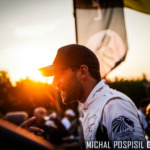

For years, Alex Fontana lived the unstable rhythm of freelance GT racing. Some seasons brought 25 race weekends. Others barely filled a calendar. As a Gold-rated professional without factory backing, long-term security was never guaranteed.
“I was not exactly swimming in race deals,” he tells GT REPORT in an exclusive interview. “You try to be downgraded. You try to find a seat. You go from having a lot to having nothing. That’s not enjoyable. It’s frustrating.”
So instead of waiting for a call, Fontana built his own grid — launching his own driver academy and using coaching as a way to stabilise and expand his racing career.
Birth of the AF Race Performance Academy
“The AF Race Performance Academy was born in 2022,” Fontana explains. “We are three people: myself, Matteo della Pietra — my business partner in many things — and my wife, Federica.”
Federica manages customers, social media, event organisation and looks after people at the track. Matteo handles administration. “The boring stuff,” as Fontana puts it. “Pay things, get paid for things.” And Centro Porsche Ticino and TM Fabio Comin take care of the support on track.
Fontana focuses on driving and coaching.

The idea started almost as a joke.
“You always have the classic friend or sponsor saying, ‘When can I try your car?’ I was always laughing at it. I never thought it would actually become something real, especially not in GT3.”
GT3 was unrealistic. But GT4 opened the door.
“With the Cayman especially, there’s no clutch to start. You can put two seats in. And differently from karting or single-seaters, in GT you can coach directly in the car.
“I can drive and the new driver sits beside me and sees immediately what is good and what is not. Then we swap and I sit beside him. I can say, ‘Brake later if you want, but brake harder.’ You can teach live.”
He contrasts it with traditional test days.
“Instead of doing ten days of testing alone, in one or two days with a coach sitting next to you in the car, you improve massively.”

But from the beginning, the academy was never meant to be a simple ‘experience day’.
“The idea was to show a professional racing team. Not a real driving experience where you do five laps, they tell you to go slow to survive and you go home with a Facebook picture.”
Every participant works with an engineer between sessions. Data is reviewed. The structure mirrors professional racing.
“Even if someone books the car for half an hour, it’s still a proper racing team environment.”
From coaching to career structure
What started as an idea became strategic.
“At that time, as a freelancer without a factory contract and as a Gold-rated driver, I was not having so many things. Some seasons five races. Some seasons 25.”
So he reversed the logic.
“Instead of waiting for somebody to call me to drive with them, I started making the drivers.”
Out of roughly 30 people coming through the academy, maybe three or four could realistically start racing. Of those, perhaps one had the budget, time, capability and progression potential to reach GT3 level.

“By developing them from the beginning, I could follow their career steps. With some people I would just coach them in their races. With some people I would start to drive with them.”
And that had a direct impact on his own performance.
“By driving more, I was improving myself as a driver as well. And that led me to have more contracts and deals elsewhere.
“The Tsunami RT connection, for example, began just because we met at International GT Open when I was driving for another team, sometimes with good results. The International GT Open programme began with an amateur driver who came directly from my racing school.
“Without the academy, I probably would not have been in GT Open in the last two seasons. And without GT Open, I would not have been in Bathurst.”
What initially looked like a side project turned into structural stability.
“It opened a lot of new possibilities.”
Coaching as a skill

The academy has also sharpened his analytical side.
“There are many fast drivers in the world. But not many drivers are capable of explaining why they are fast.”
Some have instinct. Few can translate it.
“That’s why you can have a very good driver who is not a good coach. Or a very good coach who maybe in his career was not the fastest.”
For Fontana, coaching is about entering someone else’s mindset.
“When I coach someone, I need to understand what kind of driving style he has. Everybody has their own style. I cannot force him to drive like me.
“You need to treat him like somebody who, if he had started racing as a child, could potentially become a professional and very fast racing driver. If you look at some amateurs today, it’s amazing that they can lap within one second or one and a half seconds of a full factory driver. It’s insane if you think about it.
“Imagine what it could have been if he started karting like we did at three, five or ten years old.”

That perspective shapes how he approaches development.
“So when I look at somebody, I first try to understand what he already does well and work on that.”
He sees the opposite mistake often.
“Many coaches fail to understand that because they are good drivers, everybody must drive like them. That’s wrong.”
He sees it in racing as well.
“You can have a Silver driver who is very good. Then he gets paired with a factory professional. Suddenly he struggles. Why? Because he tries to drive the car like the pro. He follows his data blindly because ‘he’s the factory driver, so he must be right.’ And sometimes the team even pushes that idea.”
But copying does not guarantee improvement.
“Even if the professional explains what he does, it doesn’t always work. Maybe the Silver just doesn’t drive like that. He’s not capable of doing it in the same way. But maybe he can be very strong doing something slightly different.”

That is where coaching becomes individual.
“My job is not to make them look like me. It’s to understand what they need to actually become better.
“That’s also a good business mindset, not just in racing.”
Experience has made him pragmatic.
“I tried to find my own way. And I understood very quickly that if you want to enjoy teaching, you need to see progress. And to see progress, you need to be humble. It’s not about you. You are there for them. Not vice versa.
“If you understand that, you will have a good time in Pro-Am classes.”
Working with teammates
That analytical mindset applies to himself as well. He brings that approach into race weekends, even alongside someone as experienced and successful like Fabio Babini at the most recent Bathurst 12 Hour.
“Fabio doesn’t need to be told anything. He has 25 seasons more than me. But if I go quicker in a session and there is a small corner detail that can help him, I’m very happy to share it.”
The respect runs both ways.

“And even if Fabio or whoever else is faster or slower than me by a second, five tenths, one tenth, it doesn’t matter. I will still look at his data.
“Maybe this driver is three tenths slower overall, but there are two corners where he is quicker than me.”
The goal is not individual ego. It is collective improvement, especially when sharing the car with amateurs racers.
“In these line-ups, the main focus is not me gaining two tenths. It’s helping the amateur gain half a second.”
And that is where the philosophy becomes very clear.
“Sometimes I even look at amateurs for myself. Imagine an amateur is three seconds slower than you. You would think it’s silly to look at his data. But if he is losing three tenths in every corner and in one corner he only loses one tenth, that means something is possible there.
“Maybe I can improve in that corner as well. So I look at everything.”
Control over destiny

The academy has shifted Fontana’s relationship with his career.
“In the past, I looked at every new race opportunity as something that could launch me higher. If I do well, maybe I get another seat. Maybe a factory contract.”
Now the approach is different.
“The more I drive with different teams, the more contacts you have. You are more in control of your destiny.”
In 2026, that control is visible. Fontana returns to a full-season GT World Challenge Europe Endurance Cup campaign with Lionspeed GP in Bronze Cup.
The programme is not directly linked to his academy, but the introduction came through the broader network built around his racing and coaching work.
“In this scenario I have right now, it’s me choosing what I do. I can choose where to race and with whom.”

His calendar includes more than 20 race weekends across GT3 and GT4. Much of it Porsche machinery. Some of it alongside drivers developed through his own programme.
“I don’t even like calling them customers anymore. They’re kind of friends now.”
Enjoying the journey
At 33, Fontana’s perspective has matured.
“Now I just try to enjoy every weekend I’m able to race. It doesn’t matter if I do five races or 25. If you always focus only on the result, you don’t enjoy the journey anymore.”
The AF Race Performance Academy began as a practical solution to instability. It became a philosophy.

Alex Fontana at the Bathurst 12 Hour
The coaching mindset carried straight into the Bathurst 12 Hour, where preparation, communication and working closely with teammates — particularly around a circuit as demanding as Mount Panorama — become just as important as outright pace. Fontana’s approach to guiding and supporting those around him was a key part of the weekend. You can read his full pre-race interview about the mental challenge of Bathurst and preparing the team for twelve hours on the edge here.