
When Max Verstappen announced his plans to race a GT3 car at the Nürburgring, many fans were surprised to learn that even a four-time Formula 1 World Champion couldn’t simply jump into a car and race. Before he could line up for the Nürburgring Langstrecken-Serie (NLS), Verstappen had to earn a special licence: the Nordschleife Permit, officially known as the DMSB Permit Nordschleife (DPN).
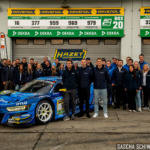
Having completed the required course and races, Verstappen made his competitive debut in NLS9, where he and fellow course mate Chris Lulham took a commanding victory in the Emil Frey Racing Ferrari 296 GT3.
The world’s toughest circuit comes with its own licence
The Nürburgring Nordschleife is unlike any other racetrack on earth. Over 20 kilometres long and packed with blind crests, narrow sections, and constant elevation changes, it demands complete respect. Because of this, Germany’s motorsport authority, the DMSB, requires all drivers to hold a specific Nordschleife racing permit before competing in high-performance machinery.
The system was introduced in 2015 after a series of serious accidents, to ensure that every driver—professional or amateur—has the necessary experience to race safely on this uniquely challenging and crowded circuit.

Four levels of the DMSB Permit Nordschleife
There are now four levels of the Nordschleife permit, each corresponding to the type of car and event:
- Permit C – For RCN Race Schwedenkreuz and Youngtimer/FHR events.
- Permit B – For NLS, 24h Qualifiers, and the 24 Hours of the Nürburgring in lower categories (V2–V5, H1, H2, BMW M240i Cup, etc.).
- Permit A – For the fastest cars such as GT3 (SP9), GT4 (SP10), and Porsche Cup entries.
- Permit M – New for 2025, for exclusive manufacturer brand cup races.
Each level builds on the next: drivers begin at C, progress to B, and finally earn A before racing in a GT3.
Understanding licences: National, International, and FIA grading
To race competitively, drivers need a racing licence issued by their national motorsport authority under FIA regulations. These range from National (Grade A) to International (Grades D to A), with higher grades allowing competition in faster and more demanding events worldwide.
Professional drivers are also assigned FIA driver ratings—Bronze, Silver, Gold, or Platinum—based on experience and achievements. Verstappen, as a Formula One World Champion, holds a Platinum rating. Because of this, he could skip the entry-level Permit C and some of the racing requirements of Permit B, instead qualifying through the DMSB’s advanced training programme for experienced professionals.

How to earn the permit
Permit B
Drivers with a National A licence must complete at least three RCN Leistungsprüfungen (performance tests) since 2022. Those holding an International D licence or higher can also qualify by completing the official DMSB Permit Nordschleife training course, which includes classroom theory, on-track instruction, and supervised laps in a road-legal car.
Starting in 2026, drivers holding an International D licence (or higher) can also take a sim racing route: they may complete three of the four DNLS winter races cleanly and in classification, and take part in one RCN performance test. This combination is recognised by the DMSB as sufficient experience for Permit B.
Permit A
Permit A is earned through race experience. A driver must complete at least two classified race results in NLS or the 24h Qualifiers since 2021, with a minimum of 14 race laps and 20% driving time per race. For FIA Gold or Platinum drivers, a double start in one event may be accepted as equivalent. Once complete, the driver can apply for the Grade A licence, valid for GT3 participation.
Verstappen’s path to the permit
Verstappen completed his qualification during NLS7 in September 2025, driving a Porsche 718 Cayman GT4 CS. Racing the Porsche alongside Lulham, he met all the required conditions, completing full stints under varying weather conditions and gaining experience with flag zones, Code 60 phases, and mixed-class traffic. The pair’s car finished safely with all laps classified, fulfilling the DMSB’s requirements for the Permit A.
With his permit secured, Verstappen entered NLS9 in the Emil Frey Racing Ferrari 296 GT3 and won outright—his first race at the Nordschleife as a GT3 driver.
Inside the system: a Nürburgring racer’s path to Permit A

While Verstappen’s rise through the permit ranks drew global attention, many local drivers are working through the same process on their own terms.
Few know the Nordschleife as well as Richard Schäfer. Born and raised in Adenau, the local racer has spent his life around the circuit, from setting the RCN VT1 lap record in 2021 to becoming RCN class champion in 2022 and scoring an NLS podium in 2023. He now coaches other drivers and has raced both with rent2Drive’s Cayman GTS ‘Fluffy’ and STENLE Marketing by Mertens Motorsport’s Hyundai i30 N this season, making him eligible for his Permit A—only the paperwork still to go.
From his perspective, the permit system genuinely raises driving standards. Racing in NLS, he says, feels more disciplined and safer than in RCN, where no permit is required.
“The behaviour on track in RCN, where you don’t need a permit, compared to NLS, where you do, is night and day. In RCN, you might start your race two laps after the leaders, as classes start stacked after each other, and there can already be three Code 60s on track. In NLS, it’s much better in my experience. So far, I haven’t raced with a full GT3 field like at the beginning of the season, but there were many Cup Porsches that are fast and aggressive—and even then, I had no issues, not once, with making space for them or sharing the track. Everyone does their own race and focuses on overtaking in the most efficient way. In my opinion, that’s done much better in NLS. It might be because of the permit system, but it could also be because of the greater experience level among the drivers, which is part of what the permit aims to ensure, but is also linked to many pro drivers being in NLS.
“The system has real value. NLS actually introduced a rule where drivers can be randomly selected to retake the permit exam. So any driver applying for an NLS race can, in theory, be asked to do the exam again. In my last race with ‘Fluffy’, I had to do it again and had to score 100 percent to be allowed to race. It’s a ten-question exam with a mix of modules, same as the online permit exam, and only if you pass can you take part. It’s a good reminder, especially when you did the original exam months before, for example during winter, and may have forgotten some things since then. I think NLS does this very well.”
Safety, experience, and a hint of bureaucracy

The Nordschleife permit reflects Germany’s fondness for structure and regulation, but that structure serves a vital purpose. With more than 130 cars often sharing the track—from top-class GT3s to modest production racers—the DMSB system ensures that every driver understands the rules, traffic flow, and risks of racing on such a vast and unpredictable circuit.
Even for the world’s best drivers, the permit is a reminder that the Nordschleife is its own world, and mastery there must be earned, not assumed.
Key facts: DMSB Permit Nordschleife 2026
- Permit A required for GT3 cars (SP9)
- Permit A requirements: Minimum 2 classified NLS or 24h Qualifiers results since 2021 and 14 race laps total
- Valid indefinitely (Grade A downgraded to B after 5 years of inactivity)
- Permit B required for lower classes (SP10, Cup, V categories)
- Permit B requirements:
- Route 1: Three RCN Leistungsprüfungen (for drivers with a National A licence)
- Route 2: DMSB Permit Nordschleife training course + supervised laps (for International D or higher)
- Route 3 (since 2026): Sim racing route via DNLS — three clean, classified DNLS winter races plus one RCN performance test (for International D or higher)
- Permit B requirements:
- Issued by the DMSB
New to GT racing?
Curious why the Nürburgring needs its own licence, or how GT3 racing fits into the wider endurance world? Explore our other explainers on topics like Balance of Performance, the DTM, 24-hour races, and the differences between GT1, GT2, GT3 and GT4. Browse all explainers here and get up to speed.
Love what we do? Support GT REPORT with a donation and fuel our next trip to the racetrack.
Even €5 makes a difference!