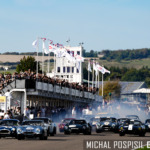
From 18 to 20 September, Goodwood Motor Circuit once again became one of the most remarkable places in the world for anyone who loves historic motorsport.
The Revival is much more than a historic race meeting. For three days, the circuit recreates the atmosphere of its original 1948–66 era, with period clothing, music, cars, motorcycles, aircraft, shops and paddock scenes surrounding an intensely competitive racing programme.
This year’s Revival added another layer through its La Dolce Vita theme, celebrating Italian culture and motoring. Maserati marked 100 years of competition, while more than 300 pre-1967 Italian scooters helped open the circuit each morning in a colourful celebration of Vespa, Lambretta and Italian design.
But beneath the glamour, there was serious racing. Fifteen races filled the programme, ranging from pre-war machinery and 1950s Grand Prix cars to sports-racing prototypes, Formula Juniors, production saloons and the closed-cockpit GTs of the RAC TT. The Stirling Moss Memorial Trophy returned to its traditional Friday evening slot, while the Lavant Cup and Brooklands Trophy were back on the programme.

The racing provided stories throughout the weekend. Alexander van der Lof and Yelmer Buurman won the Stirling Moss Memorial Trophy in a Ferrari 250 GT Berlinetta SWB, while Richard Wilson took the Lavant Cup in a Maserati 250S – fitting in a weekend celebrating the Italian marque. Patrick Blakeney-Edwards won the Brooklands Trophy in an Alfa Romeo 8C 2300, James Davison took the Whitsun Trophy in a McLaren-Chevrolet M1B, and Bonamy Grimes and Johnny Mowlem won the Sussex Trophy in a Lotus-Climax 15.
There was also the Barry Sheene Memorial Trophy for 500cc Grand Prix motorcycles, another poignant reminder of the characters whose stories have become part of Goodwood’s identity.
And then there were the drivers. Jenson Button, Jacques Villeneuve, Dario Franchitti, Scott Dixon, Tom Kristensen, Emanuele Pirro, Romain Dumas, Jimmie Johnson, André Lotterer, David Brabham and many more brought experience from the modern racing world to machinery from the past.
Yet among all those famous names, two stories stood out above the rest. One belonged to a man who had been gone for more than a decade. The other belonged to a race that happened 60 years ago. Both were brought back to life at Goodwood.

Remembering Jack Brabham
This year marks 100 years since the birth of Sir Jack Brabham and 60 years since his third Formula 1 World Championship.
There have been many great racing drivers, engineers and team owners. Jack Brabham was all three. His third title in 1966 remains one of the most remarkable achievements in Formula 1 history, because he won it in a car carrying his own name. He is still the only driver to have won the World Championship in a car of his own construction.
Goodwood’s celebration set out to capture the breadth of that career, bringing together a collection of cars connected with Brabham and his racing life. The parade included championship-winning machinery and cars associated with some of the greatest drivers of the era, including Bruce McLaren, Dan Gurney, Denny Hulme, Graham Hill and Jochen Rindt.
Leading that gathering was Jack’s son, David Brabham. For David, however, this wasn’t simply a celebration of a famous racing driver – it was a family story.
“It’s incredibly special, there’s no doubt about it,” Brabham told GT REPORT.

He spoke about the enormous effort that had gone into the celebration, the owners and customers who had brought their cars and the mechanics and engineers who had worked alongside his father in the 1960s and 1970s.
“The family here, a few mechanics and engineers that worked with my father back in the day are here as well. It’s hard to put into words because it’s quite an emotional thing to talk about. I appreciate the love that people have got towards my father and family, it’s very touching,” Brabham said, a note of humility in his voice.
David had driven the Brabham BT5 and BT20 during the weekend, the latter particularly significant because it was the car in which his father finished the 1966 season. But the cars were only part of the experience, and he deliberately kept his own racing commitments light.
“I deliberately only had one race this weekend, which was Friday night,” he explained, “which meant I had the weekend to really have time to absorb everything around me. Just sitting on the grid, just watching, looking, listening to people talk and the sound of the engine.”
It was perhaps the most fitting way for a son to experience a celebration of his father: not rushing through it, just absorbing the moment.

David Brabham posing with 1959 Cooper Climax and 1966 Brabham BT20 on the right
Back in his father’s cars
For David, one of the most personal parts of the weekend was climbing back into his father’s machinery – and the BT20 above all.
“So, always very special to jump in it,” he said.
The experience wasn’t entirely straightforward. “The engine was running a little bit rough, so unfortunately it didn’t run as cleanly as we would like. Other than that, they’re just such a lovely car to drive. So light and nimble and powerful as well for what they are.”
That description is revealing. The car that carried Jack Brabham to the end of his 1966 championship season wasn’t being treated as a museum piece. It was being driven, and David could feel the qualities his father had worked with six decades earlier.
There was another special detail, too. “It was great to have Emerson Fittipaldi next to me in one of the Coopers.”
For a brief moment, the grid brought together generations and memories in a way that could only really happen at Goodwood: David Brabham in his father’s championship-era machinery, Emerson Fittipaldi alongside him and the cars running together on the same circuit where so much of British motorsport history had unfolded.
“Like I say, it’s just been a very emotional and very touching kind of moment,” David said.

David Brabham in Brabham BT20 in the Jack Brabham Celebration
“I remember my dad more in a garage than anything else”
For David, the strongest memories of Jack are not necessarily of Grand Prix victories or championship celebrations. They are of a workshop.
“I remember my dad more in a garage than anything else. Our family had a farm, and my dad spent much of his time in the workshop, making and modifying things.”
Standing in Goodwood’s recreation of a period workshop brought those memories back. “For me, that brings back a lot of memories of my father in the workshop, making things.”
That image perhaps says more about Jack Brabham than any list of achievements ever could. “He just was hands-on and he was an innovator and a pioneer.”

His career was built around that mentality. He was part driver, part engineer and part problem-solver, someone who could look at a racing car and immediately start thinking about how to improve it. David remembered his father working through problems when others had already gone to bed.
“He could look at a problem and solve it and improve it always,” he said.
Then came the story of Monaco. Jack was leading the Monaco Grand Prix into the final lap when he crashed into the hay bales at the final corner. The obvious story is that the leader made a mistake. David remembers something different.
“He was trying to fix an engine all night. He never slept. While other drivers were resting, Jack had been working. He was extremely good at left-field thinking and finding solutions to problems.”
That was the Brabham spirit, and it was also what made his 1966 championship so significant. He had not simply climbed into somebody else’s successful machine. He had helped create it.
The legacy continues
The Brabham name did not disappear with Jack. David remains involved in motorsport, mentoring and developing drivers, while the next generations of the family are still racing. David’s nephew Matthew races in America, Jeffrey races historic machinery in the United States and Sam races in Australia.
“Three generations of racers are continuing,” David said.
That perhaps explains why the Goodwood celebration felt different from a conventional historical tribute. This was not simply a collection of old photographs and old cars. The Brabham story is still being written, and David is still part of it.

André Lotterer posing for a photo by the Brabham BT20
Goodwood turns back the clock
There are moments at Goodwood when the past stops feeling like history. It arrives in the sound of an engine firing somewhere behind the paddock, in the smell of warm oil and fuel, in the sight of a priceless racing car being pushed towards the pit lane, its bodywork still carrying the scars and patina of another era.
And sometimes it arrives in the golden evening light, when a modern racing driver stands beside a machine built for a world that disappeared decades ago. That was the scene in front of us after the final race of the 2026 Goodwood Revival.
André Lotterer had just won the RAC TT Celebration, the blue-riband race of the weekend, sharing a Jaguar E-type Lightweight Low Drag with Lukas Halusa. Yet there he was afterwards, out of his racing overalls and dressed in a vintage-looking grey suit and white hat, looking almost like a smartly dressed gangster from 1930s cinema.
Behind him was an extraordinary recreation of a garage that could have belonged to Sir Jack Brabham himself, complete with authentic tools, equipment and period details. In the warm evening light, one of Brabham’s championship-winning cars sat quietly inside. A few metres away, the noise and tension of the RAC TT were beginning to fade.
For a moment, the decades seemed to collapse into one another: a modern endurance-racing star, a 1960s Jaguar, a Brabham Formula 1 car and a Goodwood garage recreated as it might have looked in Jack’s own time. It was almost the perfect image with which to end a weekend built around the idea that motorsport history doesn’t have to remain in the past. At the 2026 Goodwood Revival, it was alive, moving and racing again.
The three Fords that conquered Le Mans
If the Brabham celebration gave the Revival its human heart, another anniversary provided one of its greatest spectacles. Sixty years after Ford’s famous 1-2-3 at the 24 Hours of Le Mans, all three of the victorious Ford GT MkIIs were reunited at Goodwood.
It was an extraordinary sight: three cars that had once spearheaded Ford’s all-out assault on Ferrari, together again six decades later. And Goodwood did not put them behind glass. They ran.

Le Mans 66 top three Ford GT40s running at Goodwood Revival 2026
The three GT40s appeared throughout the Revival, with some of the biggest names in endurance racing taking turns behind the wheel, including nine-time Le Mans winner Tom Kristensen, five-time winner Derek Bell, Emanuele Pirro, André Lotterer, Benoît Tréluyer, Marcel Fässler, Jimmie Johnson, Scott Dixon and Hélio Castroneves.
For Lotterer, the experience was almost surreal. “I never thought I would be able to sit in this car and drive it, especially here,” he told GT REPORT.
And this was not just any GT40. It was P/1046, the actual Le Mans winner driven by Bruce McLaren and Chris Amon, and the modern endurance racer could not resist giving the historic machine a little taste of its old character.
“I gave it a little push, so that was fun. It was something really, really unique. Goodwood is great for this kind of moments,” Lotterer added.
A modern driver meets Le Mans history
Lotterer has driven GT40s before, but he explained that the experience was different.
“The tyres, the conditions and the way the car felt all played a role. This one felt very stable, so it was nice,” he said.
Yet what interested him most was not the driving itself but the story behind the machine. Asked what fascinated him most about the 1966 Le Mans victory, he paused briefly before focusing on Ford’s extraordinary commitment to defeating Ferrari.
“I think it’s incredible what, how much effort they put in to beat Ferrari. And what they came with and the professionalism that Ford put to win this race.”
Then came two words that perhaps sum up the entire Ford story for Lotterer: “No compromises.”
Ford had entered its third major attempt at Le Mans with a huge operation, including seven-litre GT40 MkIIs across three factory-backed teams, alongside supporting MkIs. The result finally broke Ferrari’s stranglehold on the race. For Lotterer, the speed with which Ford turned its ambition into victory was just as impressive.
“How they got there in such a short time was very impressive.”
At Goodwood, six decades later, that result could be seen, heard and felt all over again. The three cars that had once changed the balance of power at Le Mans were back on a racing circuit.

André Lotterer with 1966 Le Mans 24hrs winning Ford GT40
The final act: the RAC TT
Through Saturday and into Sunday, the weekend built towards the race everyone had been waiting for: the Royal Automobile Club Tourist Trophy Celebration.
The RAC TT is the flagship contest of the Revival, recreating the spirit of the Tourist Trophy races once held at Goodwood with spectacular closed-cockpit GT machinery from the early 1960s. The 2026 grid was packed with names familiar from modern international racing, with Jenson Button, Jacques Villeneuve, Dario Franchitti, Scott Dixon, Jimmie Johnson, Emanuele Pirro, Romain Dumas and André Lotterer among them.
But when the engines fired on Sunday afternoon, the names disappeared beneath the noise. There were only the cars – Jaguar E-types, Shelby Cobras, Lister-Jaguars, TVRs and AC Cobras – and the narrow ribbon of Goodwood tarmac between them.
Tom Ingram and Jack Tetley started from pole in their AC Cobra, with Ingram chasing a third consecutive TT victory. That dream ended early when Tetley spun at St Mary’s on lap seven. Meanwhile, the Jaguar E-type Lightweight Low Drag of Lukas Halusa and André Lotterer began its fight towards the front.
Halusa’s opening stint was crucial. Starting from sixth, he handed the Jaguar over in second place and set the stage for Lotterer. Then the race changed.
Confusion in the cockpit
When Lotterer climbed into the Jaguar, he knew the car had a chance. His teammate had been driving faster than he had ever seen him drive.
“When my teammate started, he started driving really fast,” Lotterer told GT REPORT. “He never drove as fast.”
Halusa had been lapping in the 1m27s, then suddenly he was doing 1m25s. “I thought, wow, we have a chance.”
Lotterer went on the attack and passed several cars. But there was something he didn’t know: the Jaguar had been given a three-second penalty for a marginally out-of-position start. All he saw was P2 on the pit board.

“I didn’t understand,” he said. “I didn’t see anyone in front.”
So he kept pushing. Ahead on time was Andrew Jordan in the Shelby Cobra, and as the two cars encountered traffic, the outcome remained uncertain. The Jaguar had to overcome both the penalty and the Cobra itself, and Lotterer did exactly that.
His best lap, 1m25.318sec, was faster than Halusa’s already impressive 1m25.882sec. Five laps from home, the German began closing the final gap to Jordan. Only on the final lap did he understand what had happened.
“Finally on the last lap, I understood that we won the race.”
The margin at the flag was approximately one second. After a race of pressure, traffic, penalties and pursuit, Lukas Halusa and André Lotterer had won the 2026 RAC TT Celebration.
Behind them came the Shelby Cobra of Andrew Jordan and Matthew Holme, with Fred Wakeman and Jimmie Johnson completing the podium in the Lister-Jaguar Coupe. Mike Whitaker and Dario Franchitti finished fourth in the TVR Griffith, while Tom Ingram and Jack Tetley recovered to fifth.
For Lotterer, it was his third Goodwood Revival victory – and, fittingly, it came in the race that forms the centrepiece of the entire weekend.
“It’s my third win here, it’s amazing,” Lotterer said with a smile.

André Lotterer and Lukas Halusa celebrating their RAC TT Celebration race victory
“Something magical”
For Lotterer, the victory was only part of the experience. He has competed at some of the world’s greatest circuits and won the Le Mans 24 Hours three times, yet Goodwood continues to offer something different.
“The Goodwood Revival, it’s amazing,” he said. “There’s not any other sport where you can enjoy something that honours your sport at such a level of detail.”
He spoke about the work of the Duke of Richmond and the entire Goodwood team. “It’s just something magical. We’re very lucky that someone is doing that at this level and that we can just be here and enjoy it.”
For a driver who has spent much of his career at the highest level of modern endurance racing, that is a remarkable thing to say about a historic racing event. But standing in the paddock after his RAC TT victory, it was easy to understand why.

André Lotterer doing burnouts in the Jaguar E-type Lightweight Low Drag after winning the RAC TT Celebration race
When history comes alive
The sun was dropping over Goodwood when our conversation ended. The frantic atmosphere of the RAC TT was beginning to fade and the crowds were slowly moving away from the circuit. The Jaguar that had just won the Revival’s most prestigious race was no longer fighting for position.
Lotterer had changed out of his racing gear. Now dressed in that grey vintage-looking suit and white hat, he posed beside the iconic Brabham BT20 in a beautifully arranged garage and took pictures of it himself.
Yet the scene around him belonged to another decade entirely. Inside the recreated Brabham workshop, the tools and equipment were exactly where they needed to be, and the championship-winning car sat quietly beneath the lights. Sixty years earlier, Jack Brabham had driven a Brabham-Repco to his third World Championship.

Sixty years after Ford’s famous Le Mans triumph, the three GT40s that made history were roaring around Goodwood again. And only minutes earlier, Lotterer had been fighting for victory in a Jaguar that first raced at Goodwood more than six decades ago.
The stories and the people were different, and the technology had changed, but the feeling remained remarkably familiar. That is the magic of the Goodwood Revival. It does not simply put old racing cars on a circuit and ask us to remember.
For one extraordinary weekend, it gives those cars another life and their drivers another story. And it allows the rest of us to stand at the edge of the track and, just for a moment, believe that the past has never really gone away.
Goodwood Revival 2026 photo gallery
Photos by Michal Pospisil