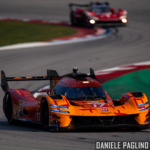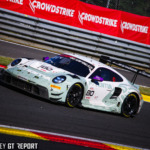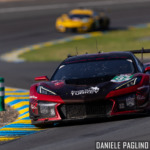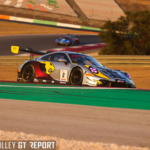

A victory at the 24 Hours of Spa and a GT World Challenge Europe powered by AWS Sprint Cup title have made Lionspeed GP’s first Pro Cup season one to remember. Behind the results, however, is an approach that was established long before the team entered the fight for overall honours. Team owner and driver Patrick Kolb explains how Lionspeed turned its ambitions into a winning operation.
The step from Bronze Cup to Pro Cup brought plenty of changes for Lionspeed. More people, another car and a different level of competition all came with the expansion. For Kolb, though, the expectations within the team were already in place. “It was always very clear for us that wherever we go, we go to win races,” he tells GT REPORT in an interview. “It’s always been that philosophy. I think that’s also attracted the right kind of people, who understand this. There are obviously a lot of aspects to motorsport, but we bring 110 percent performance wherever we go.”
‘That has been our philosophy all along’
The foundations were laid during the team’s Bronze Cup campaigns in 2024 and 2025. Having Bastian Buus and Ricardo Feller sharing the cars provided a reference against which the operation could measure itself, regardless of the category in which it competed. “That was always super important, because that obviously motivates every single person in the team to go the extra mile,” Kolb explains.
“Regardless of whether we’re in the Bronze Cup, Silver Cup or wherever, even at the 24-hour races where we had a full Bronze line-up, the goal was always to be the benchmark among the Bronzes. We’ve always treated it as if we are racing at the absolute highest standard. From that aspect, nothing’s really changed. We’ve had that philosophy since 2024, when we started. But now, obviously, scaling that over two cars and being able to expand that effort is key, trying to keep the quality where we set it up.”

That ambition needed to be ‘translated’ into something the drivers can use. With limited running before the competitive sessions begin, the preparation back at the workshop becomes an important part of what happens on track. “We have a very good team. We have a fast car this year as well,” Kolb says. “That obviously doesn’t only come through the drivers. It also comes with what material the guys are given.
“I think we’ve found a very good basis to keep a very good base set-up on the car, which isn’t a big surprise for the drivers, so they can also get into the rhythm. There’s not much time to adapt before the races, so having a good baseline is always important.”
The race that put Lionspeed GP on the map
The demands then change between the championship’s two formats. In Sprint Cup, there is little time to recover from a difficult starting position. Over an endurance race, the pit wall has more opportunities to influence how the afternoon, or the night, unfolds. “In the sprint season, it’s always important to get your timing, especially in qualifying, right,” he continues. “I think that’s what got us the sprint championship: especially the strong qualifying performances and being out there at the front, trying to stay out of trouble. That’s really been the key this year.”
The CrowdStrike 24 Hours of Spa-Francorchamps offered a very different test. Starting from the pit lane left Lionspeed with the entire field ahead, but the team worked its way into contention and eventually took a spectacular victory. “The race where we got onto everyone’s radar was Spa, which was quite a masterpiece on the strategy side, but also obviously on the driving side,” Kolb proudly looks back.
“I think getting through the entire field goes a bit with our philosophy. It’s kind of like: ‘Okay, good, just keep your head down and keep on going and do what you know works.”
Running two cars in the same weekends
For Kolb personally, the expansion has added another dimension to a race weekend. He still has his own driving duties, while the progress of the Pro entry is never far from his thoughts. “In the past, the last two years when we were competing in the Bronze Cup, we only had one car running there. So my focus was only on that car,” he explains.

“Now you have a situation where you have split interests. Obviously, you’re driving your own race and want to perform and be successful there. But you also always have half an eye on the Pro car. During race weekends I always try to stay out of the operational side of things. There’s been a lot of work, sweat and tears going into this project and making it happen.”
Away from the cockpit, that project required the organisation to grow without losing the standards on which it had been built. Kolb credits those responsible for the daily running of the team with making that possible. “The entire operation has scaled quite significantly. Personnel has doubled, finding all these people, and every single one of them has had their influence on the success this year,” he says.
‘It always got taken away from us’
Looking at the trophies alone, it would be easy to overlook how frustrating the opening part of the season was. Lionspeed had already shown enough pace to suggest it could compete at the front, but turning that into results proved more difficult. “We saw our performance from the get-go. At Paul Ricard, we were already strong. The team was in contention for the overall podium in the first race,” Kolb recalls.
“We got the first double pole for Porsche in GT World Challenge Sprint. We had the technical issue again, the same technical issue which we had at Paul Ricard, which was kind of out of our hands. Then, with Monza, being taken out on lap one, again being in a good position. In the beginning, it just seemed like, whatever we were doing, we were trying to do things right. It was showing the potential, which was nice. But then it always got taken away from us again.”
Even the weekend that would change the season initially threatened to follow the same pattern. “At Spa, we had that big setback where we seemed to be there again on performance, and everything seemed good. Then we had to start from the pit lane, which in the past had always been the red line for how the rest of the weekend was going to evolve.”
This time, Lionspeed’s work was rewarded. Kolb reaches for a German expression to describe what followed: a Sommermärchen, a summer fairytale. “From the 24 Hours of Spa onwards, it just seemed to have flipped the coin,” he says. “Everything that we had been putting into it already started to pay off with the win at Spa. It’s already a season which I think absolutely everyone would have signed up for at the beginning of the year. We never would have thought that it would come so early, in the first year of the effort.”

Lionspeed
Bringing a title back to Weissach
The Sprint Cup championship added another milestone, one that extended beyond Lionspeed’s own garage. “Porsche has been trying to win the sprint championship for the past 14 years, since the championship has existed,” Kolb says. “We’ve now been able to bring that title back to Weissach, which is obviously super special. With all of the setbacks, that we are still able to fight for the overall drivers’ championship just says a lot about what has come out of this.”
Speaking ahead of the Portimão finale, Kolb expects the Portuguese circuit to ask plenty of the same people who have helped deliver that success. A couple of days of winter testing provided a reference, but the warmer conditions and a field of around 60 cars bring fresh challenges. “The main thing all of the cars are going to struggle with a lot is pick-up on the track, especially if you have to go offline through traffic,” he explains.
“I think it’s going to be mainly one of those races where the guys in the pit box do their magic with getting the strategy right and utilising all of the situations which will probably come up in the race.”