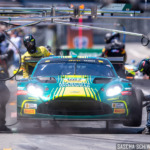

Mercedes-AMG is working on a successor of the AMG GT3. It’s one of the most established and successful platforms in GT3 racing. The German manufacturer is on an exciting journey to renew and improve the succes formula.
On March 24, 2026, Mercedes-AMG has officially revealed that its next-generation GT3 is in development, using the Concept AMG GT Track Sport as its technical foundation. Prototype testing already began in October.
Earlier in March, during the NLS2, GT REPORT sat down with Stefan Wendl, Head of Mercedes-AMG Customer Racing, to speak about the successor of the Mercedes-AMG GT3. “I’m quite happy with what we currently have – it works well in this car,” Wendl says.
“It’s no surprise that we’re working on a derivative of the Mercedes-AMG GT family. We are developing it at the moment.”
The evolution of the Mercedes-AMG GT3 platform
The current Mercedes-AMG GT3 has no trouble competing with newly developed GT3 cars, like the Lamborghini Huracán GT3 Evo or the Ferrari 296 GT3 Evo. “I think the success comes from starting with a really strong base car: the road car,” Wendl continues.
“It’s built on a front-engine concept with a transaxle gearbox in the rear. That gives the car very good drivability for both professional and gentleman drivers. We took the strengths of that concept and added all the motorsport DNA to it when we developed the car in 2015 [and raced with from 2016].”
The next step was made with the evolution that was homologated in 2020. “Since then, we’ve continued running this car, and it still has enough performance potential. We can adjust power, weight, or aerodynamics to match the development of our competitors.”

“That said, there are many strong cars on the grid, and the competition is not standing still. We are facing tough opposition, and it’s not easy to win races,” Wendl points out, highlighting the hard work behind the scenes at the Customer Racing teams.
A strong trait of the Mercedes-AMG GT3, is that the aerodynamics feel very stable for a front-engine car. Wendl predicts the same for the successor: “The aerodynamics are already very stable, based on feedback from the drivers.”
“Whether that will be taken to an even higher level is something I can’t go into detail about yet, as we are still in the development phase. In general, aerodynamics are regulated within a defined performance window, including maximum downforce, efficiency, and power-to-weight ratios.”
How Performance Drivers help with improvement
Within those boundaries, Mercedes-AMG continues the quest for the sweet spot. The immensely talented Performance Drivers all add to that. After every race or test, they submit a report, which is shared with the technical team.
“From these reports, we extract insights that are useful for current development, ongoing improvements or even long-term projects like a new car or future evolutions,” Wendl explains. “It’s important to listen not only to lap-time-based feedback, but also to subjective input – things like ergonomics, driver comfort, and how intuitive the controls and software systems are.”
Wendl emphasizes that those factors are crucial in reducing driver stress and helping them feel completely at home in the car. “Every driver plays a role in this process. For dedicated development work, we have Thomas Jäger.”
The Mercedes-AMG specialist and former DTM driver (Seasons 2000-2003) – a highly values colleague who has been involved in the Mercedes-AMG Customer Racing Programme since its inception in 2010 – works closely with the Performance Drivers. “Together, they are responsible for embedding the AMG DNA into our motorsport cars.”
Love what we do? Support GT REPORT with a donation and fuel our next trip to the racetrack.
Even €5 makes a difference!