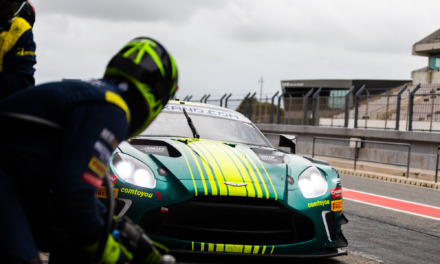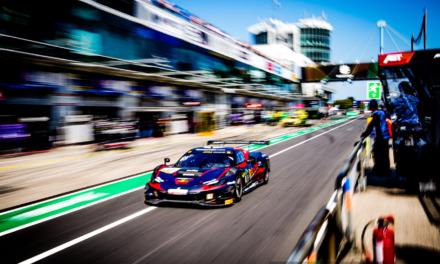
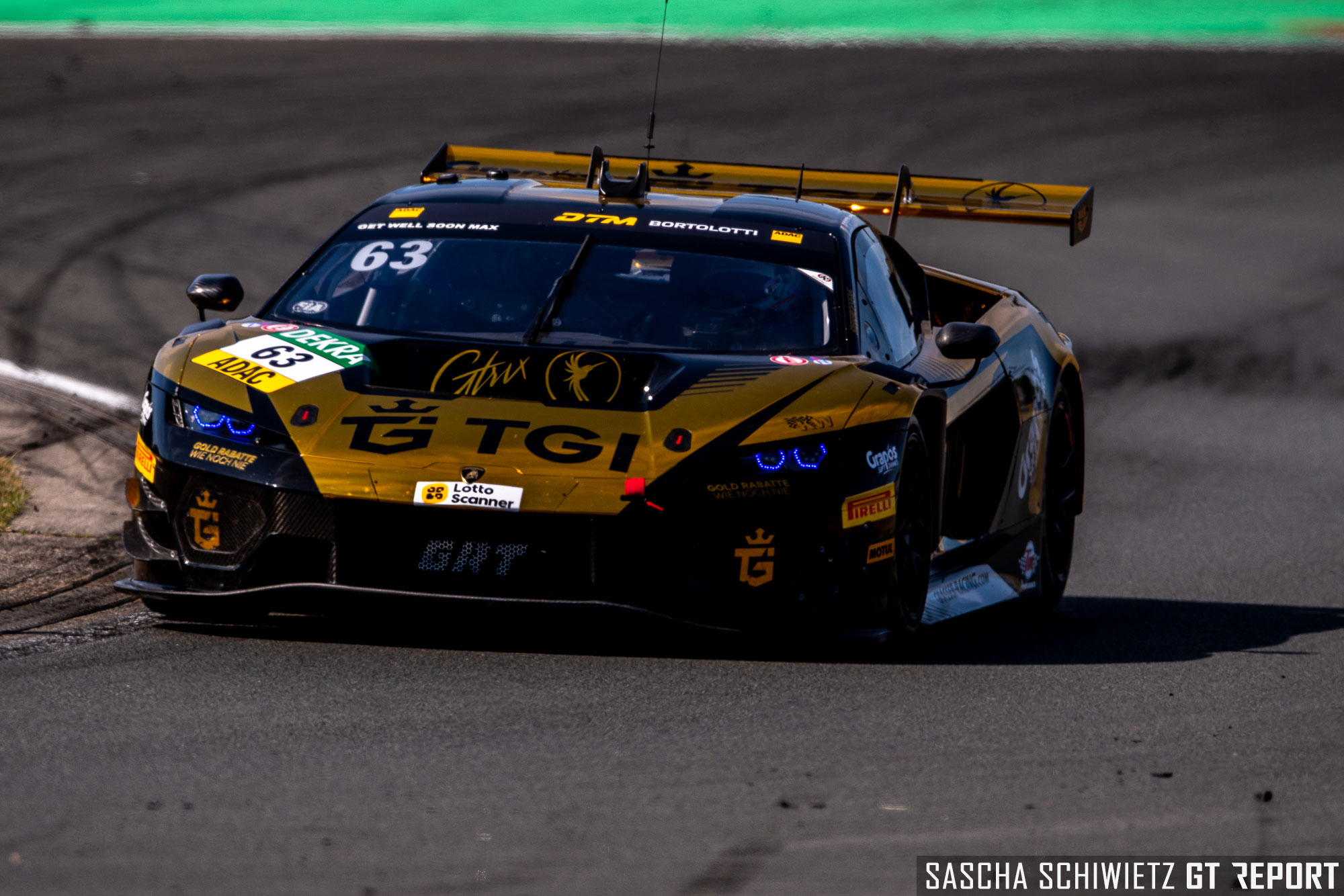
Lamborghini’s Temerario GT3 is well into its first season of competition, but Mirko Bortolotti makes clear that the project is still very much in its learning phase. The new car has already shown flashes of potential, yet the search for a consistent working window continues.
For Lamborghini, every kilometre in 2026 is an investment in making sure the same process does not have to be repeated next year. The Temerario represents a major step for Lamborghini Squadra Corse. It is the first GT race car designed and developed entirely by the Italian manufacturer and, while it shares its origins with the road-going Temerario, the GT3 uses a non-hybrid version of its 4.0-litre twin-turbo V8.
Together with Grasser Racing Team, Bortolotti was part of its European debut at Paul Ricard. The car’s racing life started a little earlier already at Sebring in March, where Pfaff Motorsports ran the car in its global race debut. As GT REPORT reported ahead of that first race, the Canadian team had already been heavily involved in the development process before the car entered competition. Several months and championships later, however, the work is far from finished.

At the Nürburgring, Bortolotti’s first impression after practice was not particularly encouraging. The Italian felt that the Temerario was struggling more with the faster corners of the Grand Prix layout than it had on the shorter configuration used by the DTM. “It was the first time we drove the car on the Grand Prix Strecke – the longer one. We were not at the top, struggling a bit,” he says in an interview with GT REPORT.
“I felt like the car worked better on the slower version of the track, which we use in DTM. With the high-speed corners that we have on this layout, it seems like we’re struggling a bit more.”
Starting from scratch: the Temerario is a completely different car
Comparisons with the Huracán GT3 are almost inevitable. Lamborghini spent more than a decade refining that platform, culminating in a car capable of fighting across a wide variety of circuits. Bortolotti, however, stresses that the Temerario is not simply the next evolution of the same concept.
“Everything,” he starts, “Mechanically, aerodynamically, powertrain. Everything is completely different. So it’s really not comparable, the two platforms,” Bortolotti emphasizes. “The Huracán is a car that we know really well, a car that we have developed over the years continuously. It was a really solid package. Probably not the quickest car on the grid, but a really, really solid platform that more or less managed to be competitive on both low-speed tracks and high-speed tracks.
“But also, in that case, it was not a car that started as a winner in the first year. We proved that with good quality work over the last 10 or 11 years, we managed to get to a product that was, in the end, solid.”
With the Temerario, that process has effectively been reset: “We start from a completely new base, and we haven’t really taken much from the Huracán – I would say nothing, actually. It’s basically a completely new car, so we start again from scratch,” Bortolotti continues.

“We have to learn the whole thing again. In certain conditions and certain situations, we see in different championships that sometimes we hit it in the right way, we get into the window. On other days, maybe we are completely out of the window. It’s a process. It will take time.”
The first 24-hour race showed potential
It’s easy for people from the outside to draw conclusions based on simple timetable results, but what’s underneath is more important for Lamborghini. One of the biggest tests so far came at the 24 Hours of Spa, where two Temerario GT3s contested the car’s first 24-hour race. For Bortolotti, Franck Perera and Maximilian Paul in the #63 Grasser Racing Team entry, the race ended prematurely following technical problems.
The #96 Rutronik Racing car of Luca Engstler, Marco Mapelli and Patric Niederhauser did reach the finish, taking 19th overall. Despite the final result, Bortolotti believes Spa was one of Lamborghini’s strongest GT World Challenge Europe showings. The car’s underlying performance was particularly encouraging.
“In GT World, it’s been fairly negative so far. In terms of results, we were not competitive on any of the tracks. I think Spa, looking at the races we’ve had, was probably the best in terms of performance. But unfortunately, we had to retire. So there’s a lot of work ahead of us, and we know that,” he says.
The first season has not been without signs of what the Temerario can eventually become. Bortolotti appeared to deliver the car’s maiden DTM victory at Oschersleben in July. However, the #63 GRT Lamborghini was later disqualified because a wheel bearing did not comply with the Temerario’s DTM homologation.

On the other side of the Atlantic, the car has already converted its potential into results. Pfaff Motorsports scored back-to-back GTD Pro victories at Road America and Virginia International Raceway, demonstrating the kind of competitiveness Bortolotti describes when the car lands in the right operating window.
Throwing darts in the dark
The challenge is making that working window repeatable. Championships like GT World Challenge Europe does not give teams unlimited opportunities to experiment during a race weekend. With three drivers rotating through the car and a packed field limiting the number of clean laps, Bortolotti says there is little time to make major setup changes.
“What we’re doing right now, is still trying to throw darts in the dark. Sometimes we hit it, sometimes we’re completely far away from it,” he says. “It feels like a consistent practice session rather than going to the next weekend being more or less sorted out and doing the detail work you need on that weekend to adapt to the conditions and the situation.”
When asked what the biggest difficulty about that situation is, Bortolotti points out the foundations of a stable platform still have to be build: “We don’t have a base to start with, and this is our biggest issue, I think.”
An investment in 2027: ‘I know what we’re capable of as a team’
That also changes the definition of a successful weekend. Immediate results remain important to Bortolotti and Lamborghini, but the bigger objective is making sure every piece of information gathered now can be used next season. “With every race you do, every mileage you do, every situation you face, it is something that will be super valuable next year,” Bortolotti explains.
“No matter which championship, which team, it will be very crucial. Everything we learn now is an investment into the future, basically. We’re not investing into immediate results here and now, which is a shame, because I know what we’re capable of as a team. We’ve proven it many, many times in the past in many different environments.”

Bortolotti is keen to separate the current situation from the capabilities of the teams and people involved. In his eyes, the task is purely to accelerate the development of the car: “The work we’re carrying out is work that you should have already bagged before the season starts. That is not the case for us, so it’s learning by doing during the race weekend, which is not ideal.”
He emphasizes that everyone is working incredibly hard. “We are trying to make the most of it. We’ve also had days where we hit it really well and we were competitive. As soon as the opportunity arises, we need to be there to seize it. The priority right now is to prepare ourselves well in order to not have another season like that next year.”