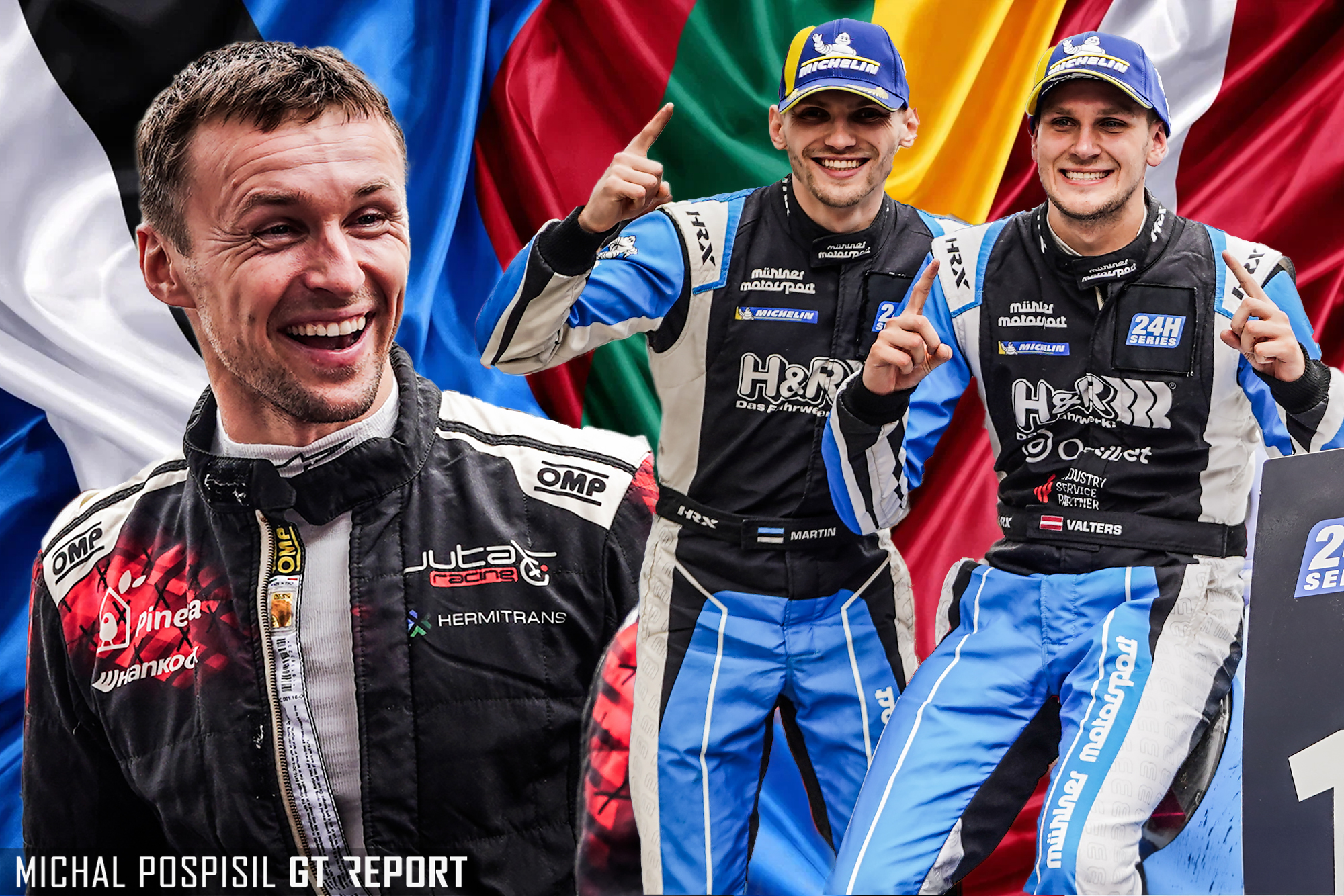
The Baltic states rarely dominate international circuit racing headlines, yet spend enough time in endurance paddocks and a clear shift becomes visible. In Barcelona during the 24-hour race there, GT REPORT spoke to Lithuanian GT racer and entrepreneur Arūnas Gečiauskas, Juta Racing team manager and driver Jonas Gelžinis, and Latvian rising star Valters Zviedris about the past, present and future of motorsport in the region. Their stories are about late starts and steep learning curves, limited infrastructure and tight budgets, but also about belief, ambition and a growing sense that Baltic teams and drivers are no longer here simply to participate.
Many racing fans are familiar with the long and well-documented motorsport histories of countries such as Great Britain, Italy and Germany, where the sport has been deeply rooted in national culture for generations. Even a casual enthusiast can usually name a world champion, a legendary team, a famous circuit or an iconic event from those established motorsport nations.

But what about other parts of Europe, where motorsport can feel more distant or even exotic? How many teams or drivers can you name from Eastern Europe or the Baltic states? If you are not from that region yourself and still have a strong grasp of its motorsport landscape, you likely qualify as a true motorsport aficionado.
In late September, GT REPORT was present at the final round of the 24H European Series in Barcelona, where more than 30 entries contested the championship-deciding 24-hour race of the 2025 season. While preparing for the event and studying the entry list, one pattern quickly emerged. The grid was dominated by teams and drivers from Germany, France, Great Britain, Belgium, the Netherlands and the United States.
That was hardly surprising given those countries’ long-standing motorsport traditions. What did stand out, however, were the entries from less familiar regions. One team in particular caught our attention: Lithuanian outfit Juta Racing, along with one of its drivers, Arūnas Gečiauskas. The entry list also included drivers from Latvia and Estonia, forming a rare Baltic presence on a major international endurance grid.
Rally roots and circuit ambitions

Mārtiņš Sesks at the 2024 WRC Rally Latvia in Rīga.
When motorsport in the Baltic states comes to mind, rallying is often the first discipline people think of. For followers of the World Rally Championship, Estonia’s Ott Tänak stands out immediately. In 2019, he ended Sébastien Ogier’s reign to become Estonia’s first world champion.
Tänak recently made headlines by announcing his temporary retirement from rallying. While his absence will be felt across the region, another name has been gathering momentum. Mārtiņš Sesks has emerged as Latvia’s rallying sensation, rapidly climbing the ranks as he looks to establish himself on the world stage.
Lithuania’s motorsport history is also deeply rooted in rallying, with the Lithuanian Rally Championship long considered the country’s flagship competition. But what about circuit racing, and GT racing in particular?
In the post-Soviet era, motorsport in the Baltic states gained a new lease on life through improved access to international competition, modern technology and professional structures. Drivers from Lithuania, Latvia and Estonia have since ventured into disciplines ranging from karting and single-seaters to rallycross and endurance racing, with several carving out careers on European and global stages.

AX Latvia at Pilskalni.
Arūnas Gečiauskas: From Baltic circuits to the GT3 grid
On Sunday morning, with three hours still to go in the 24-hour race, the Barcelona paddock was unusually quiet. Only a handful of mechanics and team members were awake, grabbing breakfast and coffee with visibly tired faces. For many, caffeine intake had likely reached double digits over the past 24 hours.
At the far end of the pit lane sat the Juta Racing garage. There, we found Arūnas Gečiauskas with a cup of espresso in hand, preparing for his morning stint in the Audi R8 LMS GT3 EVO II. Gečiauskas is a business entrepreneur and racing driver who entered GT3 competition via the Baltic Touring Car Championship and the European TCR Series, and who also has an extensive background in time attack and Fast Lap events.
We asked Gečiauskas how he first caught the motorsport bug and what challenges he faced along the way.
“I was always very curious and interested in motorsport. Back then, I was peeking under the fence at the race track to see how the guys were racing. I did not know it was possible, or how you could learn it unless you started as a child.
“I began when I was about 28, which is quite late. I learned everything myself through test days. At first the progress is very steep, then the learning curve flattens out. Gradually I started getting results and just kept building from there. Later on, simulators came into play, which helped a lot.”

L-R: Lars Viljoen, Arūnas Gečiauskas, and Nicola Michelon.
What about the circuits available in Lithuania when he started racing?
“We had only one track, built during Soviet times, where the average speed used to be around 90 kilometres per hour. Today, on that same track, we are doing 150 to 160 kilometres per hour on average. That is an average across the whole circuit.
“It means the track is not really safe, but it was the only one we had. Local drivers started BMW Cup and Renault Clio Cup championships, spectators began to show up, and that is how it grew. Across the three Baltic states, we have three circuits at a similar level. And believe me, they are very bumpy!”
Gečiauskas says with a nostalgic smile.
Building the future: Lithuanian Motorsport Park
When asked about the future of motorsport in Lithuania, Gečiauskas’ optimism is clear.
“Right now, we are building a brand-new circuit to FIA Grade 3 standards, and I am one of the investors. It will be about 100 kilometres from our capital. It will be the newest circuit in the Baltic states built in the last 15 years, with the latest regulations.
“Construction started this year and we expect it to be ready within two years. There are people, there is capital, and there is belief in the project. Even local municipalities are contributing land and funding.
“We expect it to boost tourism as well. Maybe it will not bring immediate returns, but over time, through infrastructure and surrounding services, it should make Lithuania more attractive for international series. We have even discussed the possibility of hosting the 24H Series.”
The project he refers to is Lithuanian Motorsport Park (LMP), which began development in 2021. At its heart is an FIA Grade 3 and FIM C-compliant 3.3-kilometre circuit designed for high-level competition. The wider complex is intended to combine motorsport infrastructure with leisure facilities, including modern pit buildings, spectator areas, a professional karting circuit, and dedicated spaces for driver training and drift activities.
Money, sponsorship and the reality of racing

In a country where basketball remains the most popular sport, motorsport still faces an uphill battle for attention and funding. We asked Gečiauskas how difficult it was to finance a racing career in the past compared to today.
“Lithuania is currently not very involved in motorsport. We gained independence in 1991, so there was basically no private capital and very limited opportunities for those with the talent who grew up in that generation. This sport demands significant capital.
“For me, it’s really hard to compare because I never searched for sponsorship, but I know how others struggled. In the early days, no one really looked for sponsors because no one knew how, and no one had money. You raced with whatever you could afford.
“Today, it is easier in some ways, but also more expensive. A season in Formula 4, Formula 3 or even top-level karting can easily cost 200,000 euros. There are people now who are already a businessman generation and the first generation that got really rich. We are giving it to the youngsters, just to ease their start. Because the older the businessman in Lithuania, the more he is willing, the new generation will be kicking up much quicker than it was in his generation. I know, I’m trying myself now.”
Sim racing as a gateway

Arūnas Gečiauskas and Nicola Michelon.
Sim racing has become an increasingly important entry point for young drivers in the region.
“It’s a very easy, cheap way to learn. So the guys already proved in Lithuania that those who spend a lot of time in the simulator are very quick on the real track as well.
“For the ones in Lithuania who are winning the sim championships, we’ve got the programme that they are going straight to the track to check if they are really good as in the simulator. And yeah, it’s part of the question that Lithuania is not too much into motorsports. But there are a couple of organisations that are arranging those esports contests. And the contest is about if you are winning that year, then you get a seat for the Baltic BMW 325 Cup, for example. And you can show if you have what it takes.”
And then if you are good, sponsors might be interested?
“Sponsors are not waiting for you; if you are good, you go to the sponsors. No one is chasing you. If you are good at marketing yourself and presenting yourself as a person, maybe you have a chance.You have to be a package, not just a quick driver.”
Good piece of advice from Arūnas for young drivers.
With only a couple of hours left on the clock, Gečiauskas needed to get ready for his final stint in the car, which was running in P3. That would be the team’s best result of the season and would help secure third place in the overall GT3 championship.
Jonas Gelžinis: From driver to team leader

Juta Racing is a family-run team with a long history dating back to the late 1980s. It has progressed through national championships, securing numerous victories and titles, and extended its footprint into international competitions, testing its mettle against global players. In recent years, the team has participated in the Creventic 24H Series, the Winter GT Series, and the ADAC GT Masters. Reflecting current trends, Juta Racing has also ventured into esports racing.
Shortly after our interview with Arūnas, we managed to ask a few quick questions to team principal and racing driver Jonas Gelžinis. Jonas won the Porsche Carrera Cup Great Britain Pro-Am1 class champion title in 2011. From 2012, he raced in the Pro class and finished runner-up in 2013. He is also a record ten-time winner of the Palanga 1000 km Challenge, a race held on the intersection of the Liepāja-Klaipėda coastal highway near the Lithuanian city of Palanga. He was selected for the FIA 2012 Young Driver Excellence Academy.
Jonas was also selected for the 2013 Porsche International Scholarship Cup shootout, together with Earl Bamber, Johan Kristoffersson and other top drivers from Porsche Carrera Cups. In 2023, Gelžinis was part of the driver line-up for Juta Racing’s entry into the ADAC GT Masters, marking the first Lithuanian team to compete in the series.
Jonas is a very experienced racing driver, but how is he dealing with the challenges of being the team principal?
“As a team principal, I am responsible for all projects. This weekend, we have a team split.
“Part of our team is racing here in Barcelona, and another part of the team was doing NLS, Nordschleife yesterday. And we were competing with Max Verstappen. But our driver, Frank Stippler, was racing with two teams. So we had to put in our Bronze driver, and he had an incident at the start. That was not our ideal result.”
Racing at two very competitive events at the same weekend, while the team was trying to secure its best result in the 24H Series Championship, is not an easy feat. How difficult is it, in terms of finances, resources, and logistics, for a team from Lithuania?
“I would say that the transport cost is the most minimal in this. It doesn’t cost a lot to move trucks around Europe, also, all our specialists’ costs, some of them are local, some are from Germany, some are from France. We have a good team of specialists, good main people in the team, and that helps us to do a good job for clients.”

Audi R8 LMS GT3 EVO II of Juta Racing waiting to be released from the pit lane.
Jonas sounded confident in his team. How confident is he about the future of motorsport in his country?
“Motorsport is not the most popular activity. We have basketball, but it’s growing, and we have good results. It’s getting better and better. We are building a new track so that it will be getting more popular. Maybe it might be easier in the future. We have one renovated circuit at the moment, Nemuno Žiedas; it was in a very bad condition for many years. Now we are building another one, our Motopark. I think the future is bright.”
Where does Jonas see the future of the team? Is, for example, the 24 Hours of Le Mans on the table?
“It’s hard to tell, because we didn’t expect to do so much a few years ago. I don’t know what the future brings, but we don’t have such a target as Le Mans or something like that. Because it’s a very big investment, it’s a very niche market. For me, it’s not very attractive at the moment.”
It looks like Juta Racing will focus on achieving strong results in the series it is currently involved in. Securing third place in this 24-hour race and in the overall classification would cement Juta Racing as a frontrunner.
Valters Zviedris: a Latvian rising star with endurance ambitions
Le Mans might not be immediately on the table for Juta, but it is definitely a prospect for Valters Zviedris. Valters is a 24-year-old racing driver from Latvia. Porsche Sprint Challenge NEZ Champion 2023. Baltic, Latvian, Estonian champion in BMW 325 Cup in 2022. Baltic TCR road racing class champion in 2021. Five-time national karting champion. Latvian national team member in the FIA Motorsport Games 2019 and 2022 in the TCR road racing category. Second place in the Legends World Finals race in the United States in 2018. Multiple titles as Sportsman of the Year in technical sports, and also Sportsman of the Year in 2021 and 2022, awarded by Jūrmala city.

Latvian Valters Zviedris is getting ready for his final stint.
In 2023, he moved into international endurance racing. That year, he secured victory in the GT Open category and second place overall in the Aurum 1006 km endurance race in Palanga. He also clinched the title in the Baltic Touring Car Championship 4-hour endurance series in the TC3 category. In 2025, Valters signed to compete full-time in the 24H Series with Mühlner Motorsport, driving a Porsche 911 GT3 Cup in the 992 class. In his first season, he achieved two victories, in Abu Dhabi and at Paul Ricard. When we caught up with him before his final stint in Barcelona, his car was leading the 992 class.
We asked him how his journey in motorsport started.
“Actually, it goes back to 1970, when my dad was racing go-karts. He was already involved in the sport. He never raced cars, but at that time, when our country was part of the Soviet Union, it was only really possible to race go-karts or motorcycles.
“My dad showed me karting, and I started racing when I was six years old. I did that until I was sixteen, then switched to car racing. I have driven many different cars. I started with Legend cars, then BMW 325 Cup, then TCR with Audi, and for the last three years I have been driving Porsche. I did sprint racing in the North European zone and Carrera Cup Benelux, and now I am moving more towards endurance racing.”

Local fans from Jēkabpils fly the city’s flag for their local driver Raitis Gusevs, AX Latvia at Pilskalni.
How accessible was motorsport when he started?
“In my karting days it was quite easy, because karting was very popular in Latvia when I was six years old. It was easy to find teams and ways to move forward. Of course, money is always involved in motorsport, so it is always tricky.
“When you start in karting it is not that expensive, but when you move into bigger championships, it becomes costly. Latvia is a small country economically, so sponsorship money is always an issue, but we always find ways. I am not racing purely with my own money, now or in the past. We have, of course, some family budget that has gone into it. But overall, we can always find the budget from sponsors. So, there are bigger companies that are interested in commercials and really supporting sport and younger drivers.”
Is he involved in supporting younger drivers himself?
“Yes, I am. Actually, I have my own racing team because I’m working at Porsche Latvia now. I’m teaching clients to drive their street cars. Also, we do these Porsche experiences in our local racetrack in Biķernieki in Riga. I’m also teaching how to drive in go-karts for young kids and letting them know how they can progress further.
“Motorsports is really popular not only in circuit racing in Latvia. We have drift, we have rally cross, we have rally. So, there are a lot of ways to go racing. Even Formula 1 is getting more popular now.”

AX Latvia at Pilskalni.
How does he see the future of motorsport in the Baltic states?
“I think the future in the Baltics is bright. Lithuania is building a new circuit, and karting levels in Latvia are very high now. Young drivers are progressing well. We just need to show the right pathways and help people understand motorsport as a sport and as a business.
“We already have drivers climbing the ladder. We have a Latvian racing in Formula 4, Tomass Štolcermanis, and in Estonia there are fast drivers in Formula 2, like Paul Aron, who is now a Formula 1 reserve driver. Our region is already doing well.”
Would he say drivers from the region face extra challenges?
“Yes, as a Latvian, we always have to fight for our place. It doesn’t come easy. You have to work for it, you have to show how fast you are on the track, if we talk about motorsports, but it’s like everything. In Germany, the salaries are generally higher, so the budgets are higher. For us, it’s the same amount for the seat as it is for a driver from Germany.
“So, it’s not easy, but you see, we are here. There’s even a Lithuanian team here, and also an Estonian driver in our own team. So, yeah, I think we are doing well. It’s getting better. We are managing, but it’s never easy. But I love this. I would never change anything about my decisions to go into motorsports, having this life, having to drive these cars on these tracks, it’s just amazing. You get to travel, you get to drive fast cars, see, meet amazing people and yeah, just to have a nice time, have a nice life.”

If endurance racing suits him so well, does he dream of racing at Le Mans, Spa or the Nürburgring?
“Actually, this is the dream. This is the way I want to go. Of course, it’s still a dream. It’s not like a plan, still, but you need to have dreams to succeed in something, right? So, Le Mans is the way to go because I have done a lot of sprint racing, and now I feel like endurance racing is closer to my heart. Because the team is working much more together, you can feel the spirit in the team, the emotions are much more, and this is what I enjoy about endurance racing.”
From our interview with Valters, he is a knowledgeable driver, with his focus, energy, and determination fully locked to fulfil his dream. Most importantly, he is in it with his whole heart, and you can clearly see he loves every second of it, not just in the car on the track, but also in the interaction with the team and all the people around him.
Not long after our chat, he reviewed all the data in the garage, got himself physically and mentally ready for his final stint, put on a helmet, and patiently awaited the arrival of his Porsche 911 GT3 Cup with his mechanics.
After his final stint, Zviedris secured victory in his first-ever 24-hour race. Moments later, in parc fermé, he proposed to his girlfriend. The future certainly looks bright for Valters Zviedris.

Valters Zviedris and fiancée.
Martin Rump: Estonia’s endurance benchmark
We must not forget Zviedris’ team-mate from Estonia, Martin Rump. Having started racing at the age of seven, Rump progressed through karting, single-seaters and into the highest levels of GT and endurance racing. He has stood on the podium at events such as the 24 Hours of Nürburgring and the 24 Hours of Spa, and became the first Estonian driver to compete in the 24 Hours of Le Mans, in 2022 and 2023.
Alongside his racing career, Rump has built a strong coaching background. He has worked with drivers of varied experience levels, was appointed official mentor for the Audi R8 LMS Series, and in 2023 joined Michael Fassbender’s Road to Le Mans programme alongside Porsche works driver Richard Lietz. He is also a certified trainer with a strong focus on driver preparation, fitness and mental readiness.
Baltic motorsport comes of age
After speaking to some of the best drivers the Baltic states can offer, a clear picture emerges. With the resilience of drivers like Arūnas Gečiauskas, the professionalism of Juta Racing, the ambition of Valters Zviedris, and the experience of figures like Martin Rump, the future of motorsport in the region looks genuinely promising.
Drivers from the Baltic states are not here to make up the numbers. They are here to compete, and increasingly, to win.

Martin Rump (middle left) and Valters Zviedris (middle right) with their teammates on the top step of the podium.
24H BARCELONA | QUALIFYING | RACE: MIDNIGHT UPDATE AND GALLERY | RACE FINISH REPORT | 24H BARCELONA AS A FAN | FULL GALLERY
Want to contribute?
At GT REPORT, we are always open to new contributors with a passion for GT and endurance racing. We are particularly keen to expand our coverage of national and regional series, including the Baltic Touring Car Championship.
If you are a writer, photographer or paddock regular with insight into Baltic motorsport, we would love to hear from you. Find out more about contributing to GT REPORT and how to get involved by going here.
Love what we do? Support GT REPORT with a donation and fuel our next trip to the racetrack.
Even €5 makes a difference!