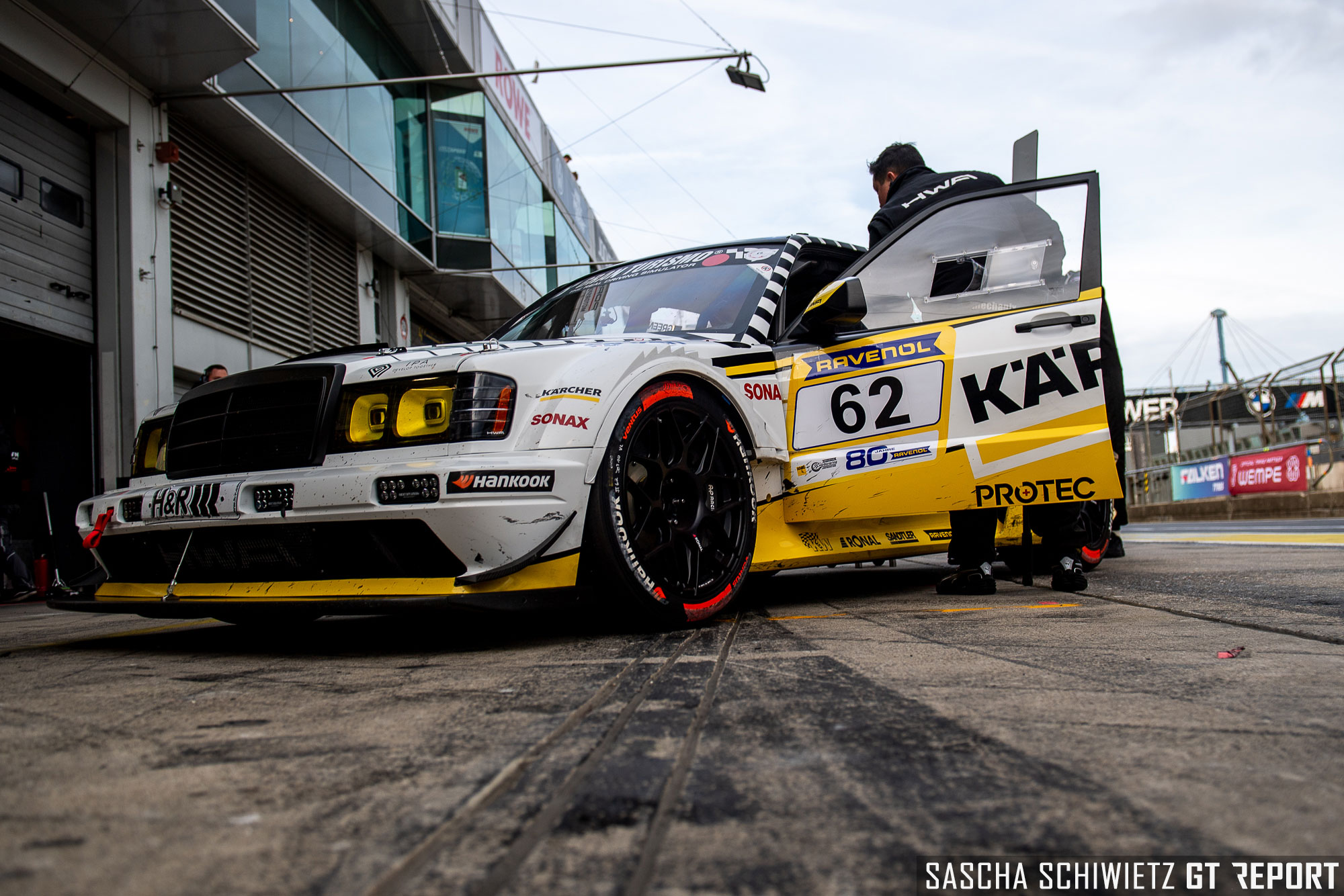

The Mercedes-Benz 190E Evo II is etched into touring car history as one of the great homologation specials. With its towering rear wing, flared arches, and Cosworth-tuned four-cylinder, it became a symbol of the DTM’s golden years. Now, three and a half decades later, that legend is back in a very different form. HWA AG, the company behind Mercedes’ success in the series, has brought the car back to life as the HWA EVO: a modern reinterpretation built with the precision of a GT racer and the ambition to take on the Nordschleife.
After its first public laps at the 2025 Nürburgring 24 Hours, HWA has entered three EVO.R race versions in the SP-X class of the 2026 edition, marking its first full factory campaign at the event under its own name.
Chassis: W201 in name only

Each one of the hundred EVOs begins its second life with an original Mercedes-Benz 190E chassis, but little of the donor shell remains. Over 75% is cut away or re-engineered, replaced by HWA-built subframes, reinforcements, and a treated cell structure that doubles torsional rigidity compared to the base car. The result is a platform closer to a modern supercar than a 1990s saloon.
To balance weight distribution, the front axle is moved forward by 50mm and auxiliary systems are shifted rearwards. Combined with a rear-mounted gearbox, this gives the car an ideal 50:50 balance for high-speed endurance work.
Powertrain: Compact V6 with dry sump and race-bred cooling

The original Evo II produced 235bhp. The EVO delivers nearly twice that from a reworked Mercedes-AMG 3.0-litre twin-turbo V6. In standard form it produces 450bhp and 550Nm, rising to 500bhp and 600Nm with the optional Affalterbach Package. The engine sits low in a front-mid layout, with a dry-sump system ensuring oil delivery under heavy lateral loads and a bespoke cooling package designed for long stints at maximum effort.
A six-speed manual gearbox mounted at the rear, links to the engine via torque tube. With a motorsport clutch and lightweight flywheel, it is built to maximise response and feel.
Suspension and brakes: DTM heritage, modern precision

Double-wishbone suspension front and rear recalls the car’s touring car roots, while KW dampers and CNC-machined uprights allow fine-tuning for track or road. Brakes are equally serious: 380mm front and 360mm rear discs with six- and four-piston calipers, plus an optional carbon-ceramic upgrade. Bosch has partnered with HWA to create bespoke ABS and ESP systems, a rare feature for such a limited-run machine.
Aerodynamics and bodywork: Heritage redefined

Visually, the silhouette remains faithful to Bruno Sacco’s design, but the materials and aero are 21st-century. Every exterior panel is made from carbon fibre, bonded to a reinforced chassis that brings total weight down to 1,360kg. Aero features include an adjustable rear wing and an adjustable front splitter with ride-height lift for road use.
Inside: Digital-retro cockpit

The cockpit mixes period cues with modern function. Amber-tinted digital instruments recall the 1990s while displaying live telemetry. Recaro seats front and rear are standard, with FIA-spec options available for those planning serious track use. Buyers can customise colours, materials, and even the instrument layout.
From demo laps to full attack

The EVO’s public debut at the 2025 Nürburgring 24 Hours featured demo laps driven by DTM greats Klaus Ludwig and Roland Asch. Both are now involved in the race car’s development programme, linking past and present in fitting style.
In 2026, HWA returns with three EVO.Rs competing in SP-X, a class reserved for non-homologated prototypes. Even more rare than the hundred-limited EVO, only three EVO.Rs will be build.
With added aero, cooling, safety, and other motorsports upgrades, the cars will go from demonstration to full endurance assault, supported by engineers from HWA’s DTM and GT3 operations. The drivers for the three cars include Bruno Spengler, Peter Ludwig, Evald Holstad, Christian Gebhardt, Sebastian Asch, Luca Ludwig, Adam Adelson, Markus Winkelhock, Jamie Green, Renger van der Zande, and Lance David Arnold, underlining the project’s growing ambition.
A true return to form

To call the HWA EVO a restomod is an understatement. It is a thorough re-engineering of a classic platform, rebuilt to perform at the highest level of modern motorsport. Carbon fibre bodywork, balanced transaxle layout, and a race-ready drivetrain ensure that this car is more than just a tribute.
As it heads for the Nürburgring 24 Hours, the EVO brings HWA back to the spotlight and gives the Mercedes-Benz 190E a new life on the stage that has defined so many legends.
Photos by Sascha Schiwietz